
Look, I’m not going to lie to you. When someone first told me it was possible to earn money online at a rate of $1 per minute, I laughed. Not because it sounded impossible—but because it sounded too simple. One dollar. Sixty seconds. Do the math, and that’s $60 an hour, $1,440 a day, or a staggering $525,600 a year. That’s the kind of income per minute that changes lives, pays off mortgages, funds dream vacations, and builds generational wealth.
In This Article
But here’s what nobody tells you: earning $1 per minute isn’t about working harder. It’s about working smarter, building scalable systems, and leveraging the explosive growth of the digital economy in 2026 and beyond. The old playbook—trade time for money, climb the corporate ladder, wait for the gold watch—is broken. The new playbook? It’s all about high-income skills, automation, and multiple revenue streams that work while you sleep.
So buckle up. This isn’t your typical “get rich quick” fantasy. This is a deep dive into the real, research-backed, proven strategies that everyday people are using right now to hit—and exceed—that magical $1-per-minute threshold. And by the time you finish reading this, you’ll have a roadmap to get there yourself.
What Does $1 Per Minute Really Mean in 2026 & 2027 and beyond
Share it with your well wishers and potential friends
Let’s break this down because context matters. Earning $1 per minute sounds catchy, but what does it actually translate to in your bank account?
The Numbers That Matter:
- Per hour: $60
- Per day (8-hour workday): $480
- Per month (20 working days): $9,600
- Per year: $115,200 (if you’re actively working)
- True potential (passive + active combined): $300,000 – $500,000+
Now, here’s the kicker: in 2026 and 2027, you’re not limited to trading hours for dollars. The digital economy has fundamentally changed the game. You can build systems that generate income whether you’re at your desk, at the beach, or fast asleep. That’s the real magic.
Why This Goal Is Achievable (But Not Instant)
Let’s get real for a second. You’re not going to wake up tomorrow and magically start earning $1 per minute. Anyone who tells you otherwise is selling snake oil. What you CAN do is build toward this goal systematically over 6-24 months, depending on your starting point, skills, and commitment level.
Here’s what makes this achievable in 2026-2027:
AI is eliminating low-value work. Tools like ChatGPT, Midjourney, and automation platforms are handling the grunt work—research, writing, design, data entry—freeing you to focus on high-value activities that actually move the needle.
The creator economy is exploding. We’re talking about a market that’s projected to hit $287 billion in 2027, up from $234 billion in 2026. That’s not a typo. The demand for content, courses, coaching, and creative services has never been higher.
High-income digital skills are in massive demand. Companies are desperate for people who can code, design, write persuasive copy, manage social media, or build AI-powered solutions. And they’re willing to pay premium rates—$60-150 per hour or more.
Automated income systems are now accessible to everyone. You don’t need to be a tech genius or have a massive budget. Platforms like Shopify, Gumroad, YouTube, and Amazon make it possible to build passive income streams with relatively low upfront investment.
The bottom line? The infrastructure, tools, and market demand exist RIGHT NOW to make $1 per minute a reality. What’s missing is your strategy and execution.
The Future of Earning Money Per Minute (2026–2030 Trends)
If you want to understand where the money is going, you need to follow the trends. The digital economy isn’t just growing—it’s accelerating at a pace that would have seemed impossible even five years ago.
The Creator Economy Explosion
The creator economy is one of the most powerful wealth-building forces in modern history. In 2026, it’s valued at $234.65 billion globally. By 2030? We’re looking at $528.39 billion. That’s more than double in just four years.
What does this mean for you? It means there’s never been a better time to be a creator—whether that’s a YouTuber, podcaster, blogger, course creator, or social media influencer. The platforms are mature, the monetization tools are sophisticated, and the audience is hungry for authentic, valuable content.
AI Replacing Low-Value Tasks, Amplifying High-Value Skills
Here’s the paradox of AI: it’s simultaneously destroying jobs and creating unprecedented opportunities. AI is eliminating repetitive, low-skill tasks—data entry, basic customer service, and simple content creation. But it’s supercharging people who know how to use it strategically.
Think about it: a freelance writer who used to research and write one article per day can now produce five using AI tools. A designer who spent hours on mockups can generate dozens of options in minutes. A developer can build in days what used to take months.
The people earning $1 per minute in 2027 aren’t competing with AI—they’re collaborating with it.
The Rise of Micro-Entrepreneurship
The traditional model of entrepreneurship—raise capital, build a team, scale infrastructure—is being replaced by solo operators who use automation, AI, and outsourcing to run million-dollar businesses from their laptops.
These “micro-entrepreneurs” are everywhere:
- A 27-year-old selling digital planners on Etsy, making $15,000/month
- A freelance developer building custom AI chatbots for $5,000-10,000 per project
- A YouTuber running a faceless automation channel generating $8,000/month in ad revenue
- An affiliate marketer promoting high-ticket SaaS products, earning $20,000+ in monthly commissions
What these people have in common isn’t luck or genius—it’s systems, leverage, and the willingness to learn high-income skills.
Automated Income Systems
Passive income isn’t new, but the tools available in 2026 make it more accessible than ever. We’re talking about:
- Digital products with 90%+ profit margins that sell while you sleep
- Print-on-demand businesses generating $3,000-10,000/month with minimal management.
- Affiliate marketing funnels that run on autopilot, converting traffic into commissions 24/7
- YouTube channels with evergreen content earning ad revenue years after upload
- Online courses hosted on platforms like Teachable or Kajabi are selling continuously without your involvement.
The key insight: you build it once, and it pays you forever (or as long as the market demands it).
Related Reading:
How to Earn 1 Cent per Second: Money Attraction Laws and Rules
How Typing Can Boost Your Productivity in this AI Era
10 Must-Have AI Tools Every Small Business Needs in 2025
How to Use ChatGPT at Work to Boost Productivity (2025)
Top 12 Proven Ways to Earn $1 Per Minute
Alright, enough theory. Let’s get into the meat of this: the actual, proven methods that real people are using right now to earn $1 per minute or more. These aren’t pie-in-the-sky ideas—they’re battle-tested strategies with clear paths to execution.
Share it with your well wishers and potential friends
1. Affiliate Marketing
How It Works:
You promote other people’s products or services and earn a commission on every sale made through your unique referral link. The beauty? You don’t create products, handle customer service, or manage inventory. You’re the connector between the buyer and the seller.
Time Requirement: 10-20 hours/week initially; scales to 5-10 hours/week once systems are in place
Time to Reach $1/Min: 6-18 months
Key Skills Required:
- Content creation (blog posts, videos, social media)
- SEO and keyword research
- Email marketing
- Understanding of conversion funnels
Difficulty Level: Moderate
Competition Level: High (but niches exist with lower competition)
Long-Term Scalability: Excellent (passive income potential)
Real Numbers:
Beginner affiliates typically earn $500-2,000/month in their first year. Experienced marketers hit $5,000-20,000+/month. Top performers? Six figures monthly. In 2026, the U.S. affiliate marketing industry alone is projected to exceed $13.2 billion.
Path to $1/Minute:
To hit $60/hour consistently, you need systems that generate passive commissions. Build niche authority websites, create SEO-optimized content, and promote high-ticket products ($500+ commissions). A single sale per day of a $1,000 product with 30% commission nets you $300 daily—that’s already above $1/minute for an 8-hour workday.
2. High-Ticket Affiliate Funnels
How It Works:
This is affiliate marketing’s bigger, more profitable sibling. Instead of promoting $50 products, you’re promoting high-value offers: software subscriptions ($1,000+ annual value), coaching programs ($3,000-10,000), or business tools ($5,000+). Commissions can be $500-5,000 per sale.
Time Requirement: 15-25 hours/week
Time to Reach $1/Min: 8-15 months
Key Skills Required:
- Advanced funnel building
- Paid advertising (Facebook Ads, Google Ads)
- High-quality content creation
- Relationship building with high-ticket vendors
Difficulty Level: Hard
Competition Level: Medium (requires investment in ads)
Long-Term Scalability: Excellent
Real Numbers:
High-ticket affiliates often make $10,000-50,000/month. Some SaaS affiliate programs pay $1,300+ per referral, and recurring commissions mean you get paid as long as the customer stays subscribed.
3. YouTube Automation
How It Works:
Create YouTube channels that don’t require you to be on camera. Faceless channels use stock footage, AI voiceovers, screen recordings, and animations to deliver valuable content in niches like finance, tech reviews, meditation, or educational tutorials.
Time Requirement: 20-30 hours/week initially; 10-15 hours/week once systemized
Time to Reach $1/Min: 12-24 months
Key Skills Required:
- Video editing (or outsourcing to editors)
- YouTube SEO
- Scriptwriting (AI tools help massively here)
- Thumbnail design
Difficulty Level: Moderate to Hard
Competition Level: Very High
Long-Term Scalability: Excellent (passive ad revenue)
Real Numbers:
YouTube CPM (cost per thousand views) ranges from $2-15, depending on the niche. Finance, tech, and business channels command the highest rates. A channel getting 500,000 monthly views with a $10 CPM earns $5,000/month. Scale to 2 million views, and you’re at $20,000/month—well over $1/minute.
4. Freelancing (Coding, Design, AI Prompting)
How It Works:
Offer specialized services to clients on a project or hourly basis. In 2026, the most in-demand skills are coding (web development, app development), design (UI/UX, graphic design), and AI-related services (prompt engineering, AI integration, chatbot development).
Time Requirement: 30-40 hours/week (active work)
Time to Reach $1/Min: 3-9 months
Key Skills Required:
- Technical expertise in your chosen field
- Client communication
- Project management
- Portfolio building
Difficulty Level: Hard (requires real skills)
Competition Level: Medium to High (but demand is massive)
Long-Term Scalability: Moderate (you’re trading time for money, but rates can increase significantly)
Real Numbers:
Freelance developers charge $40-150/hour globally, with North American developers at the higher end. Mid-level full-stack developers easily command $60-80/hour. Senior developers or specialized roles (AI/ML, blockchain) hit $100-250/hour.
Path to $1/Minute:
Simple: charge $60+/hour. With experience, you can raise your rates to $80-120/hour, making you well above the $1/minute threshold.
5. AI-Based Micro-Services
How It Works:
Leverage AI tools to offer services that were previously time-intensive: AI-generated content, voiceovers, chatbot development, social media automation, AI art generation, video editing with AI, or AI-powered data analysis.
Time Requirement: 15-25 hours/week
Time to Reach $1/Min: 6-12 months
Key Skills Required:
- Understanding of AI tools (ChatGPT, Midjourney, ElevenLabs, etc.)
- Marketing and sales
- Basic technical knowledge
- Client management
Difficulty Level: Moderate
Competition Level: Medium (still relatively new)
Long-Term Scalability: Excellent
Real Numbers:
AI service providers are charging premium rates because businesses see AI as a competitive advantage. Chatbot setup: $2,000-5,000. AI content strategy consulting: $100-200/hour. AI voiceover services for audiobooks: $500-2,000 per project.
6. Building Digital Products (Ebooks, Templates, Courses)
How It Works:
Create digital assets once and sell them infinitely. This includes ebooks, Notion templates, Canva templates, spreadsheet tools, online courses, software tools, or AI prompt packs.
Time Requirement: 40-80 hours upfront to create; 5-10 hours/week for marketing
Time to Reach $1/Min: 6-18 months
Key Skills Required:
- Expertise in your topic
- Product creation (writing, design, video)
- Marketing and copywriting
- Platform knowledge (Gumroad, Teachable, etc.)
Difficulty Level: Moderate
Competition Level: High
Long-Term Scalability: Exceptional (70-90% profit margins)
Real Numbers:
Digital product creators report anywhere from $1,000/month to $50,000+/month. Successful course creators on platforms like Teachable earn $5,000-20,000/month. One creator sold over $180,000 worth of a $15 ebook on Gumroad.
Path to $1/Minute:
Sell a $47 course and make 200 sales/month = $9,400. That’s $1/minute for an 8-hour workday. Scale to 400 sales or increase the price to $97, and you’re well above it.
7. Print-on-Demand
How It Works:
Design custom products (t-shirts, mugs, phone cases, posters) that are printed and shipped by third-party services (Printful, Printify) only when someone orders. You handle marketing and design; they handle production and logistics.
Time Requirement: 15-25 hours/week
Time to Reach $1/Min: 9-18 months
Key Skills Required:
- Graphic design or the ability to hire designers
- E-commerce store management
- Marketing (especially social media ads)
- Trend identification
Difficulty Level: Easy to Moderate
Competition Level: High
Long-Term Scalability: Good
Real Numbers:
Average POD business earns $3,200-4,600/month. Successful stores hit $10,000+/month. Profit margins typically range from 20-40%.
8. Blogging & SEO (Ad Revenue)
How It Works:
Build a content-rich website targeting valuable keywords. Monetize through display ads (Google AdSense, Mediavine), affiliate links, and sponsored content. The key is organic traffic from search engines.
Time Requirement: 20-30 hours/week initially; 10-15 hours/week for maintenance
Time to Reach $1/Min: 18-36 months
Key Skills Required:
- SEO and keyword research
- High-quality content creation
- Website management (WordPress, etc.)
- Patience (SEO is a long game)
Difficulty Level: Moderate
Competition Level: Very High
Long-Term Scalability: Excellent (passive income)
Real Numbers:
Blogs monetizing with Mediavine (requires 50,000 sessions/month) earn $15-30 RPM (revenue per thousand page views). A blog with 200,000 monthly page views can earn $3,000-6,000/month.
9. Online Coaching & Consulting
How It Works:
Package your expertise into one-on-one or group coaching sessions. This works in any niche where you have demonstrable results: business, fitness, career advancement, social media growth, relationships, productivity, etc.
Time Requirement: 20-35 hours/week
Time to Reach $1/Min: 6-12 months
Key Skills Required:
- Proven expertise in your niche
- Communication and teaching ability
- Sales and marketing
- Program structuring
Difficulty Level: Moderate to Hard
Competition Level: Medium
Long-Term Scalability: Good (can transition to group programs or courses)
Real Numbers:
Coaches charge $100-500/hour for one-on-one sessions. High-ticket coaching programs range from $3,000-20,000 for 3-6 month engagements. A coach taking on 10 clients at $5,000 each earns $50,000 for that cohort.
10. Remote Tech Jobs
How It Works:
Land a high-paying remote position in tech (software engineer, data scientist, product manager, DevOps engineer). These roles often pay $80,000-200,000+ annually, easily exceeding $60/hour.
Time Requirement: 40 hours/week (traditional employment)
Time to Reach $1/Min: Immediate (if you have the skills)
Key Skills Required:
- Technical skills specific to the role
- Remote work communication
- Portfolio or track record
Difficulty Level: Hard
Competition Level: High (but demand is strong)
Long-Term Scalability: Limited (trading time for money)
Real Numbers:
According to market data, senior software engineers in the U.S. earn $120,000-180,000/year ($60-90/hour). Remote-first companies like GitLab, Zapier, and Automattic pay competitive salaries globally.
11. Licensing IP (Templates, Tools)
How It Works:
Create reusable digital assets—website templates, software plugins, stock photos, music loops, design assets—and license them repeatedly. Each sale is passive income.
Time Requirement: 50-100 hours upfront; 5-10 hours/week marketing
Time to Reach $1/Min: 12-24 months
Key Skills Required:
- Creation skills (design, development, photography, etc.)
- Understanding of licensing models
- Marketing on platforms like ThemeForest, Creative Market, etc.
Difficulty Level: Hard
Competition Level: Medium
Long-Term Scalability: Excellent
Real Numbers:
Successful template creators earn $2,000-10,000/month from sales across multiple platforms.
12. Long-Term Investing (Medium-Risk)
How It Works:
Build a portfolio of dividend stocks, REITs, ETFs, or bonds that generate passive income through distributions. This requires capital upfront but creates truly passive returns.
Time Requirement: 5-10 hours/month
Time to Reach $1/Min: Depends on capital (could be immediate with $500,000+ invested)
Key Skills Required:
- Basic financial literacy
- Research and due diligence
- Patience and discipline
Difficulty Level: Easy to Moderate
Competition Level: Low (you’re competing with yourself)
Long-Term Scalability: Excellent
Real Numbers:
Dividend yields average 3-8% annually. REITs typically yield 4-10%. If you invest $500,000 with a 7% annual return, that’s $35,000/year or roughly $2,900/month—close to $1/minute for an 8-hour workday.
Visual Comparison of Earn-Per-Minute Potential
Let’s look at the data visually to understand where the real opportunities lie:
Chart 1
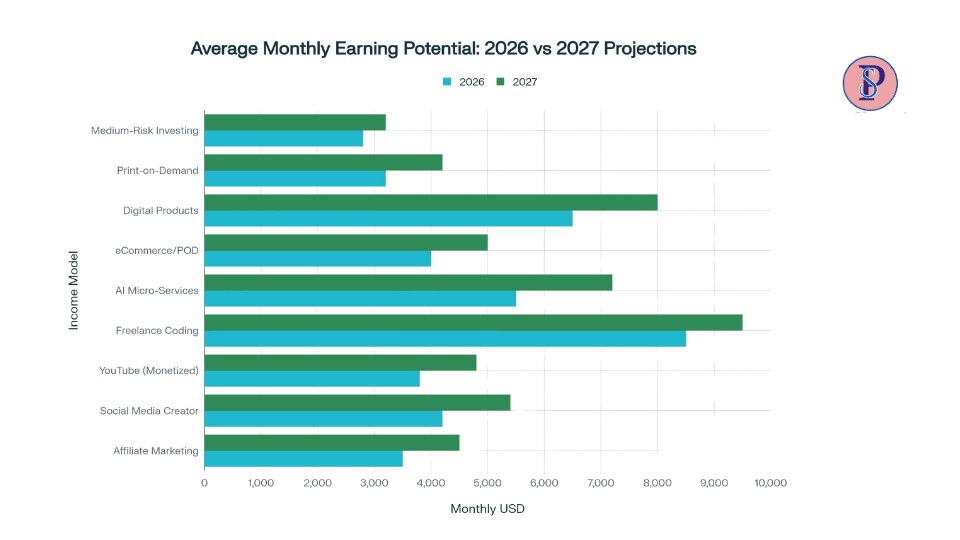
This chart shows you where the money is heading. Notice that freelance coding leads the pack in 2026, but digital products and AI micro-services show the strongest growth trajectories into 2027. Why? Because these models scale without proportional increases in time investment.
Chart 2
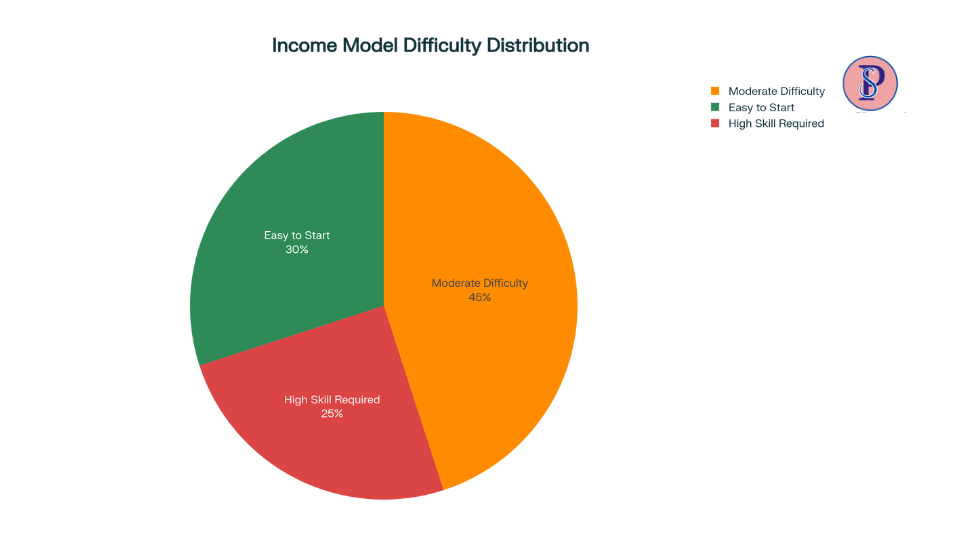
Here’s the reality check: 45% of income models fall into the “moderate difficulty” category. This is actually good news—it means the majority of opportunities don’t require you to be a genius or have a decade of experience. They do, however, require consistent effort and skill development.
Chart 3
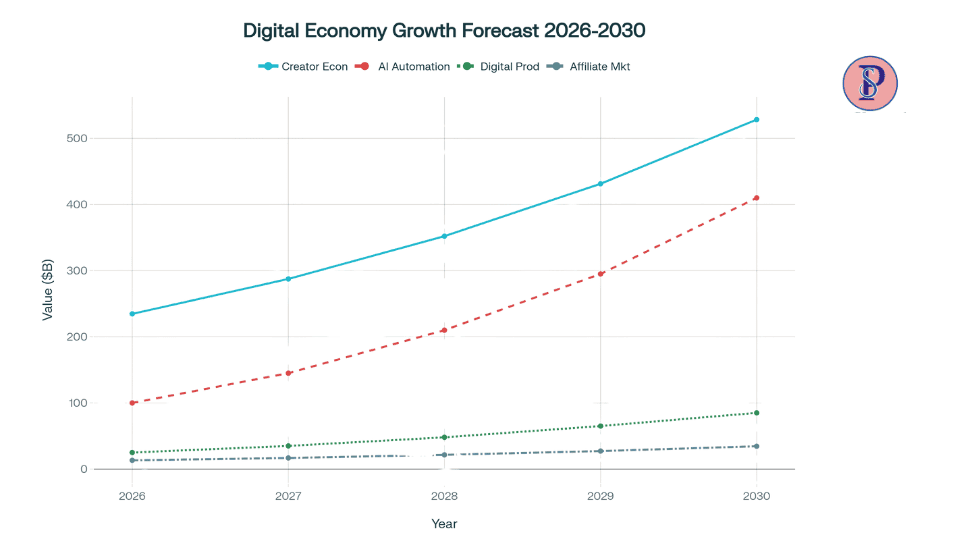
This growth forecast tells the story. The creator economy is on a rocket ship, nearly doubling from 2026 to 2030. Digital products and affiliate marketing are following close behind. The message? Get in early, build your position, and ride the wave.
Chart 4
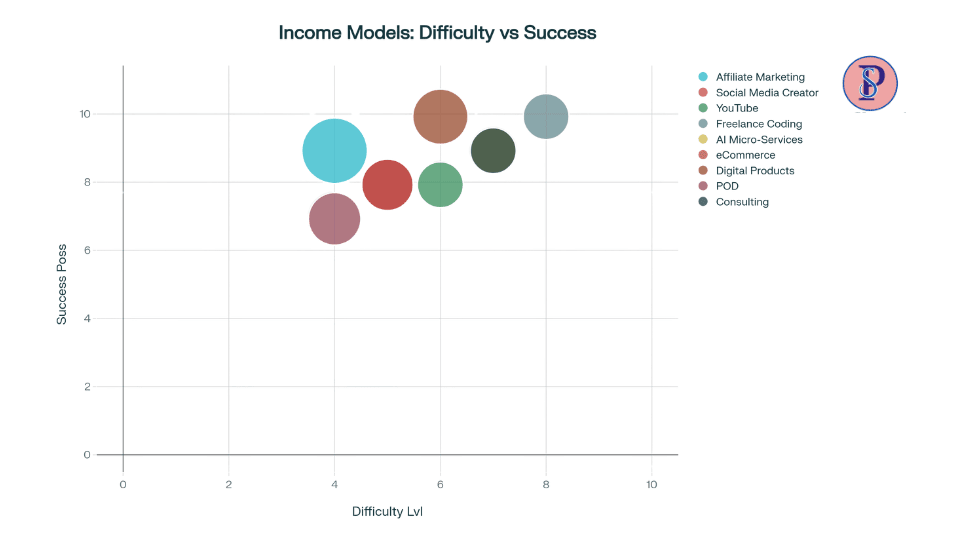
This matrix is gold. It shows you the sweet spot: income models with high success possibility but moderate difficulty. Look at affiliate marketing, digital products, and AI services—they’re all in that high-potential, achievable zone. Compare that to freelance coding, which has high success potential but also high difficulty (requires serious skills).
Share it with your well wishers and potential friends
How Fast Can You Realistically Reach $1 Per Minute?
Let’s cut through the hype and talk timelines. How fast can you actually get there?
Related Reading:
How to Earn 1 Cent per Second: Money Attraction Laws and Rules
How Typing Can Boost Your Productivity in this AI Era
10 Must-Have AI Tools Every Small Business Needs in 2025
How to Use ChatGPT at Work to Boost Productivity (2025)
Fast Track (3-6 Months)
Who This Is For:
People with existing high-income skills (developers, designers, marketers) or significant capital to invest.
Strategies:
- Freelance coding/design at $60-150/hour → Immediate
- High-ticket consulting if you have proven expertise → 3-4 months to build client base
- Investing $300,000-500,000 with 6-8% returns → Immediate passive income
What It Takes:
Hustle, networking, portfolio building, and aggressive client acquisition.
Medium Track (6-12 Months)
Who This Is For:
People willing to learn high-income skills or build scalable systems from scratch.
Strategies:
- Affiliate marketing with consistent content creation and SEO
- Digital product creation and marketing
- AI-based micro-services
- YouTube channel growth
- Print-on-demand scaling
What It Takes:
Consistency, learning curve navigation, strategic content production, and effective marketing.
Slow & Steady (1-2 Years)
Who This Is For:
Complete beginners or those building passive income alongside a full-time job.
Strategies:
- Blogging for ad revenue and affiliate income
- YouTube automation
- Long-term investing with monthly contributions
- Building and scaling digital product catalogs
What It Takes:
Patience, discipline, continuous learning, and a compound growth mindset.
The Role of Key Factors
Skills:
The faster you acquire high-income skills, the faster you hit your income goals. Coding, AI proficiency, marketing, copywriting, and video production are all high-leverage skills.
Consistency:
The difference between people who make it and those who don’t? Showing up daily. Whether it’s creating content, reaching out to clients, or optimizing your systems, consistency compounds.
Niche Selection:
Not all niches are created equal. Finance, tech, business, and health niches pay significantly more than entertainment or general lifestyle content. Choose strategically.
Content Production:
The more valuable content you produce (whether it’s blog posts, videos, products, or services), the faster you build authority and income.
AI Tools:
In 2026, AI isn’t optional—it’s essential. People using AI to 10x their productivity are lapping those who aren’t.
The Role of AI in Increasing Your Income Per Minute
Let’s be blunt: if you’re not using AI in 2026, you’re leaving money on the table. AI tools are the difference between earning $20/hour and $200/hour. Here’s how:
Writing
Tools: ChatGPT, Jasper, Copy.ai
Impact: AI can research, outline, and draft content in minutes. A freelance writer using AI can complete 5 articles in the time it used to take to write one. That’s 5x income potential.
Example: Instead of spending 4 hours on a blog post, spend 1 hour using AI for research and drafts, then polish. You’ve just turned a $240 project into $60 of actual work—quadrupling your effective hourly rate.
Coding
Tools: GitHub Copilot, ChatGPT, Tabnine
Impact: AI assists with code generation, debugging, and documentation. Developers report 30-50% productivity increases.
Example: A project that took 20 hours now takes 12. Same $2,000 project, less time, higher effective hourly rate.
Editing
Tools: Descript, Pictory, Runway ML
Impact: AI-powered video editing dramatically reduces production time. What took 8 hours manually now takes 2-3 hours.
Marketing
Tools: ChatGPT for copy, Canva AI for design, AdCreative.ai for ad generation
Impact: Create marketing campaigns in hours instead of weeks. More campaigns = more revenue.
Research
Tools: ChatGPT, Perplexity, specialized research tools
Impact: Compress hours of research into minutes. Get to value creation faster.
Social Content Creation
Tools: ChatGPT, Canva, Buffer, Hootsuite with AI
Impact: Batch-create a month’s worth of social content in an afternoon.
Automation
Tools: Zapier, Make, AI-powered workflows
Impact: Automate repetitive tasks—email responses, data entry, scheduling, CRM updates. Every automated hour is an hour you can spend on revenue-generating activities.
The Bottom Line:
AI is a force multiplier. It doesn’t replace you—it amplifies you. The people earning $1/minute aren’t working harder; they’re using AI to work exponentially smarter.
Step-by-Step Plan to Reach $1 Per Minute
Alright, enough information overload. Let’s create your roadmap.
Step 1: Choose Your Core Skill or Niche
Action Items:
- List your existing skills, interests, and knowledge areas.
- Research market demand for each (use Google Trends, keyword tools, job boards)
- Identify the intersection of what you’re good at, what you enjoy, and what pays well.
- Commit to ONE path for the next 90 days (focus is everything)
Examples:
- “I’m good at writing and interested in personal finance → Affiliate marketing or content creation in the finance niche”
- “I know how to code and want flexibility → Freelance web development”
- “I have expertise in fitness but hate selling → Create digital workout programs”
Step 2: Learn High-Income Skills
Action Items:
- Invest in quality education (courses, books, mentors)
- Practice deliberately—build projects, create samples, work for free initially if needed.
- Focus on skills that have clear ROI: copywriting, video editing, coding, SEO, paid ads, and AI proficiency.
Time Investment: 2-6 months of focused learning (1-3 hours/day)
Resources:
- Free: YouTube tutorials, free courses, documentation
- Paid: Udemy, Coursera, skill-specific bootcamps ($50-500)
- Premium: Coaching programs, masterminds ($1,000-10,000)
Step 3: Build a Scalable System
Action Items:
- Create your first offering (service, product, or content platform)
- Build processes and templates for repeatability.
- Document everything (Standard Operating Procedures)
- Test and iterate based on real feedback
System Examples:
- Freelancer: Client onboarding process, project templates, automated invoicing
- Affiliate marketer: Content calendar, keyword research process, email sequences
- Digital product creator: Product creation workflow, sales funnel, customer support automation
Step 4: Use AI to Maximize Output
Action Items:
- Identify your biggest time sinks.
- Research AI tools that address those bottlenecks
- Invest in the top 3-5 tools for your business ($50-200/month total)
- Create AI-powered workflows and templates.
Example Workflow:
Research (ChatGPT) → Outline (ChatGPT) → Draft (ChatGPT) → Edit (Grammarly) → Design (Canva AI) → Schedule (Buffer) → Total time: 2 hours instead of 8
Step 5: Build Evergreen Assets
Action Items:
- Create content/products that generate income long-term.
- Focus on SEO-optimized content that ranks for years.
- Develop products that don’t expire (courses, templates, tools)
- Build email lists for ongoing revenue opportunities.
Evergreen Examples:
- The blog post on “How to file taxes” gets traffic every year.
- YouTube tutorial on “Excel basics” gets views forever.
- Online course on “Python fundamentals” sells indefinitely.
- Affiliate review of popular software continues converting.
Step 6: Scale With Automation
Action Items:
- Automate repetitive tasks (email responses, social posting, data entry)
- Hire virtual assistants for tasks below your hourly rate target.
- Use scheduling tools to batch content creation.
- Implement systems that work without your constant involvement.
What to Automate:
- Email marketing sequences
- Social media posting
- Customer onboarding
- Basic customer service (chatbots)
- Invoicing and payment collection
- Content distribution
The Goal: Your business should be able to generate income without you being physically present 24/7.
Related Reading:
How to Earn 1 Cent per Second: Money Attraction Laws and Rules
How Typing Can Boost Your Productivity in this AI Era
10 Must-Have AI Tools Every Small Business Needs in 2025
How to Use ChatGPT at Work to Boost Productivity (2025)
Case Studies & Realistic Scenarios
Let’s bring this to life with some realistic examples:
Case Study 1: Sarah, The Freelance Developer
Background: Sarah was a mid-level developer at a tech company earning $75,000/year ($36/hour). She wanted more freedom and a higher income.
Strategy:
- Months 1-2: Built portfolio on GitHub, created case studies
- Month 3: Started freelancing on Upwork at $50/hour
- Months 4-6: Raised rates to $80/hour, used GitHub Copilot to increase productivity
- Months 7-12: Transitioned to direct clients at $100-120/hour
Results:
By month 12, Sarah was working 30 hours/week and earning $12,000/month ($96,000/year)—significantly more than her old job. Her effective rate? $100/hour or $1.67/minute.
Key Moves:
- Specialized in React and Node.js (high-demand skills)
- Used AI tools to complete projects 40% faster
- Built systems for client onboarding and project management
- Focused on retainer clients for stable income
Case Study 2: Marcus, The Digital Product Creator
Background: Marcus was a high school teacher earning $50,000/year. He had expertise in personal finance but no business background.
Strategy:
- Months 1-3: Created free content on Instagram about budgeting (built audience to 15,000)
- Month 4: Launched a $27 budgeting spreadsheet template (first month: $800)
- Months 5-8: Created a $197 digital course on “Zero to Savings in 90 Days” (average: $3,000/month)
- Months 9-12: Added email marketing sequences, launched group coaching at $997 (2-3 clients/month)
Results:
By month 12, Marcus was earning $8,000-10,000/month from digital products alone—still teaching, but with a lucrative side business. He quit teaching in month 18 when income hit $15,000/month consistently.
Key Moves:
- Built trust through consistent free content
- Started with a low-ticket offer to validate the audience
- Scaled to higher-ticket offerings
- Used AI for content creation and marketing copy
Case Study 3: Jasmine, The YouTube Automator
Background: Jasmine had no video experience but saw the potential in faceless YouTube channels.
Strategy:
- Months 1-2: Researched niche (chose “space and science”), studied top channels
- Month 3: Created first 10 videos using stock footage, AI voiceovers (ElevenLabs), and scriptwriting (ChatGPT)
- Months 4-8: Consistent 3 videos/week, slowly growing subscribers and views
- Months 9-12: Hit monetization threshold (1,000 subs, 4,000 watch hours)
Results:
By month 15, Jasmine’s channel was getting 300,000 monthly views. With a $6 CPM, that’s $1,800/month. By month 24, she scaled to 3 channels, each earning $2,000-5,000/month.
Key Moves:
- Focused on evergreen content in a passionate niche
- Used AI to 10x video production speed
- Outsourced editing once revenue hit $1,000/month
- Replicated the system across multiple channels
Case Study 4: David, The Affiliate Marketer
Background: David was a sales manager earning $60,000/year, looking for an exit strategy.
Strategy:
- Months 1-3: Built niche authority website on “best home office equipment”
- Months 4-9: Published 50+ SEO-optimized product reviews and comparison articles
- Months 10-12: Traffic grew to 20,000/month; started earning $2,000-3,000/month in affiliate commissions
Results:
By month 18, David’s site generated $6,000-8,000/month in passive income. He quit his job in month 20. By month 30, income hit $12,000-15,000/month with minimal ongoing effort.
Key Moves:
- Targeted long-tail, high-intent keywords
- Focused on products with strong commission structures (20-40%)
- Built an email list for recurring promotions
- Used AI for content research and optimization
Case Study 5: Priya, The Tech Consultant
Background: Priya had 8 years of experience in AI implementation for enterprises, earning $110,000/year.
Strategy:
- Months 1-2: Built personal brand on LinkedIn, shared AI insights
- Month 3: Landed first consulting client at $150/hour for AI strategy
- Months 4-6: Transitioned to project-based pricing ($5,000-15,000 per engagement)
- Months 7-12: Developed proprietary AI implementation framework, raised rates
Results:
By month 12, Priya was earning $20,000-30,000/month working 25-30 hours/week. Her effective rate? $150-200/hour, or $2.50-3.33/minute.
Key Moves:
- Positioned as an expert in growing field (AI)
- Moved from hourly to value-based pricing
- Created repeatable processes to deliver faster
- Built a waiting list of clients (demand exceeded capacity)
Mistakes That Stop People From Reaching $1 Per Minute
Let’s talk about what NOT to do:
Mistake #1: Expecting Fast Results
The Problem: Most people quit after 30-60 days when they don’t see immediate results. But wealth-building systems take time to compound.
The Fix: Commit to 12-18 months minimum. Set realistic milestones. Celebrate small wins.
Mistake #2: Not Building a Skill First
The Problem: Trying to make money before you have something valuable to offer. You can’t shortcut expertise.
The Fix: Invest 3-6 months in deliberate skill development before expecting significant income.
Mistake #3: Not Using AI Tools
The Problem: Competing with people who ARE using AI puts you at a massive disadvantage. You’re bringing a knife to a gunfight.
The Fix: Embrace AI immediately. Learn the tools. Integrate them into your workflows.
Mistake #4: Copying Trends Without Understanding
The Problem: Chasing every shiny object—crypto, NFTs, dropshipping, whatever’s trending—without understanding the fundamentals.
The Fix: Focus on timeless principles: provide value, solve problems, build systems, scale leverage.
Mistake #5: Not Choosing Scalable Models
The Problem: Getting trapped in models that require constant active work (hourly freelancing with no productization, for example).
The Fix: Even if you start with time-for-money trades, have a plan to add passive or leveraged income streams (products, courses, automation).
Mistake #6: Ignoring Marketing
The Problem: Building something amazing but having no one know it exists. You can’t earn if you can’t sell.
The Fix: Spend 50% of your time creating, 50% marketing. Learn copywriting, SEO, social media, or paid ads.
Mistake #7: Trying to Do Everything Alone
The Problem: Burnout, slow progress, and reinventing the wheel.
The Fix: Join communities, hire help, find mentors, invest in coaching. Collaboration accelerates growth.
The $1 Per Minute Mindset in Short
Here’s what I want you to understand: earning $1 per minute isn’t about getting lucky or having some secret hack. It’s about fundamentally shifting how you think about work, value, and income.
The old mindset: Trade time for money. Show up, do the work, get paid. Repeat until retirement.
The new mindset: Build assets, systems, and leverage that generate income whether you’re working or not. Get paid for value created, not hours clocked.
This requires:
Long-term thinking. You’re building a business, not chasing quick cash.
Skill investment. The more valuable your skills, the more you can charge.
Systems thinking. Automate, delegate, and scale everything possible.
Leverage. Use technology, AI, and other people’s time to multiply your impact.
Resilience. There will be setbacks. The winners are those who persist.
Focus. Say no to distractions. Pick one strategy and execute relentlessly.
The beautiful thing about 2026 and beyond? The barriers to entry have never been lower. You don’t need a fancy degree, a massive budget, or special connections. You need:
- A laptop and an internet connection
- Willingness to learn high-income skills
- Consistency over 12-24 months
- Strategic use of AI and automation tools
- A clear plan (which you now have)
The markets are expanding: the creator economy, digital products, AI services, and remote work opportunities are all growing faster than ever. The infrastructure is mature: platforms like YouTube, Shopify, Gumroad, and Upwork make it easy to monetize. The tools are accessible: AI has democratized capabilities that used to require teams or agencies.
So the real question isn’t “Can I earn $1 per minute?” It’s “Am I willing to do what it takes?“
Because if you are—if you commit to the strategies in this guide, leverage AI, build scalable systems, and stay consistent for 12-18 months—earning $1 per minute isn’t just possible. It’s probable.
What You’ve Learnt from the Article
We’ve covered a lot of ground here. Let’s recap the essentials:
Earning $1 per minute ($60/hour, $115,200+/year) is achievable through strategic skill development, leverage, and scalable systems. It’s not an unachievable dream—it’s a target that thousands of people are hitting right now. Every year, more than 100,000 people hit the milestone of earning $1 per minute. So, it’s not like daydreaming.
The digital economy in 2026-2027 is exploding. The creator economy is doubling, AI is creating new opportunities daily, and demand for high-income digital skills has never been higher.
There are multiple paths: affiliate marketing, YouTube, freelancing, digital products, AI services, and more. Pick the one that aligns with your skills and interests, and commit.
AI is non-negotiable. It’s the difference between working 60 hours/week and 20 hours/week while earning the same or more.
Systems beat hustle. Build once, benefit forever. Focus on evergreen assets, automation, and passive income.
Timeline matters. Fast track: 3-6 months (if you have skills or capital). Medium: 6-12 months (most people). Slow: 1-2 years (but worth it).
Avoid common mistakes: impatience, skill gaps, ignoring AI, chasing trends, and trying to do everything alone.
Now it’s your move. You have the blueprint. You understand the opportunities. You know the timeline. The only variable left? Your execution.
Six months from now, you could be earning $3,000-5,000/month in additional income. A year from now? $8,000-12,000/month. Eighteen months? You could be at or above that $1-per-minute threshold, living life on your terms.
Or, you could do nothing. Keep trading time for money. Stay in the same place. Wonder “what if.”
The choice is yours. But if you’re still reading this, I’m betting you’re ready to take action.
So close this tab, pick your path, and get to work. The digital gold rush of 2026 is happening right now. Your future self will thank you for starting today.
Let’s go earn that dollar per minute.
Share it with your well wishers and potential friends
How realistic is it to earn $1 per minute online in 2026?
Earning $1 per minute online in 2026 is absolutely realistic—but it’s not magic or overnight success. This income equates to $60 per hour or over $115,000 per year if earned actively. Thanks to advances in the digital economy, AI tools, and new monetization models like affiliate marketing, freelancing, and digital products, more people than ever are hitting this target. However, it requires strategic planning, consistent skill-building, and leveraging scalable systems. The key is to combine active income with passive income streams, automate your workflows with AI, and focus on high-value tasks. It’s less about luck and more about persistent execution and smart work.
What are the best online methods to start earning $1 per minute?
The top methods include affiliate marketing, freelance coding/design, YouTube automation, AI-powered micro-services, and digital product creation (ebooks, courses, templates). Affiliate marketing is great for leveraging product sales with minimal startup costs, while freelancing offers direct hourly earnings for specialized skills. YouTube channels can generate steady passive income via ads, and AI micro-services are a fast-growing niche with high demand. Digital products provide excellent margins and scalability. Each requires different upfront investments in time and skills but can reach $1 per minute with dedication and smart scaling.
How important are AI tools in increasing digital income?
AI tools are game-changers for boosting digital income. They massively increase productivity by automating tasks such as content writing, video editing, coding, marketing, and research. Using AI, a content creator can produce 5X more output, and freelancers can complete projects faster and deliver higher quality. AI doesn’t replace you—it amplifies your reach and efficiency, letting you earn more in less time. In 2026 and beyond, those who integrate AI tools into their workflows will dominate earning potential and outpace competitors relying solely on manual effort.
How long does it typically take to consistently earn $1 per minute?
For most people, reaching a consistent $1 per minute income takes 6 to 24 months. People with existing high-income skills or capital might do it within 3-6 months by freelancing or investing. For newcomers building scalable businesses like affiliate marketing, digital products, or content creation, it can take 6-18 months of consistent effort and learning. Patience, persistence, and building systems for passive income are essential. The timeline depends heavily on your skills, commitment, niche selection, and smart use of automation.
Can beginners earn $1 per minute, or do you need special skills?
Beginners absolutely can earn $1 per minute but need to focus on acquiring high-income, digital skills such as copywriting, SEO, video editing, coding, or AI prompt engineering. Some methods like affiliate marketing and print-on-demand offer easier entry points but still require learning and persistence. The digital economy offers many accessible paths, especially when combined with AI-powered tools and educational resources. Beginners who invest time in skill development and consistent marketing can scale to $1 per minute income within 12-24 months.
What are common mistakes that prevent people from reaching this income level?
The biggest mistakes include expecting overnight success, failing to build valuable skills before monetizing, ignoring AI tools, copying trends blindly, and not choosing scalable models. Many quit too soon when results don’t come fast. Others work hard but without systems, trapping themselves in low-leverage, time-for-money exchanges. Also, neglecting marketing means great ideas remain unseen. Avoid burnout by focusing on niche expertise, embracing automation, and building passive income sources. Failure to collaborate or seek mentorship is another pitfall; successful earners leverage community and expert guidance.
How can one scale an online business to maintain $1 per minute income long-term?
Scaling requires building evergreen assets like courses, digital products, or affiliate funnels that generate income autonomously. Automation tools like Zapier and AI-driven marketing platforms minimize manual work. Hiring virtual assistants frees your time to focus on growth areas. Consistently producing high-value content aligned with audience needs increases traffic and customer base. Diversifying income streams (e.g., combining passive ad revenue with product sales and consulting) stabilizes earnings. Regularly optimizing strategies and expanding niches keep income sustainable in a competitive market. The key is systems, leverage, and continual reinvestment in growth and efficiency.
Related Reading: