
Discover the best affordable electric sports cars under $100K. Compare Tesla Model 3, Mustang Mach-E, Ioniq 5 N specs, 0-60 times, range & ownership costs.
What Defines an Electric Sports Car?
Electric sports cars transcend traditional performance definitions through the physics of instant torque delivery. While a conventional gasoline engine builds power through RPM escalation, electric motors unleash 100% of their torque from 0 RPM—meaning a $50,000 Tesla Model 3 Performance launches with force comparable to six-figure exotic cars. True electric sports cars combine three essential elements: acceleration that hits 0-60 mph in under four seconds, dual-motor all-wheel-drive architecture for maximum traction, and integrated performance technology including track-focused driving modes. This convergence creates an entirely new category—machines that deliver everyday practicality wrapped around track-ready performance.
EPA Range vs. Actual Range: You should know EPA estimates follow standardized testing procedures that rarely reflect individual driving patterns. Cold weather reduces range by 20-40%, while highway driving at 75+ mph further decreases efficiency. Budget 15-20% below EPA estimates for realistic planning.
Choosing Electric sports car
You should know that the era of choosing between performance and sustainability has definitively ended. Today’s affordable electric sports cars deliver both—often at prices lower than conventional alternatives when calculating total ownership costs. The question isn’t whether you can afford performance; it’s which performance platform aligns with your driving priorities.
Tesla Model 3 Performance:
- Price: $47,490 MSRP
- 0-60 mph: 2.8s seconds
- Horsepower: 500 hp combined
- EPA Range: 298-321 miles
- Top Speed: 163 mph
- Key Highlights: Supercharging network advantage, industry-leading Autopilot technology, dual motors AWD, minimalist interior design
The Tesla Model 3 Performance establishes the affordability benchmark for electric sports cars, delivering acceleration competitive with $150,000+ sports sedans while starting at less than half that price. Its refined chassis tuning, responsive steering, and integrated track mode earned it recognition from Road and Track as a 2024 performance car worth celebrating. The extensive Supercharging network—crucial for enthusiasts—provides unmatched long-distance capability, with over 60,000 chargers globally available.

One day you will be at the place you've always wanted to be. Because you are born to drive.
Ford Mustang Mach-E GT/Rally:
- Price: $52,495-$55,995 (GT/Rally)
- 0-60 mph: 3.3-3.8 seconds
- Horsepower: 370-480 hp (trim dependent)
- EPA Range: 240-320 miles
- Key Highlights: Iconic Mustang heritage, genuine SUV practicality, responsive handling, competitive AWD performance
Ford’s electric performance SUV captures the muscle car spirit without fuel guzzling or excessive emissions. The Rally variant adds all-weather capability with elevated suspension geometry, AWD traction control, and trail-tuned programming—creating a genuinely versatile performance platform. Its wider stance, aggressive body cladding, and distinctive rear spoiler telegraph performance intent in ways the understated Model 3 declines to.
Chevrolet Blazer EV SS:
- Price: $62,095 (SS base)
- 0-60 mph: 3.3 seconds
- Horsepower: 615 hp combined
- EPA Range: 303 miles
- Key Highlights: Highest horsepower in class, sport-tuned suspension, ultra-competitive pricing, American engineering heritage
Chevrolet’s redesigned performance SUV delivers staggering horsepower—615 hp—from its dual-motor configuration, yet remains obscured in discussions dominated by Tesla and Ford. The SS trim includes a sport-tuned suspension, performance brakes, and an aggressive stance that legitimizes its performance credentials. At $62,095, it represents perhaps the best horsepower-per-dollar value available in this segment.
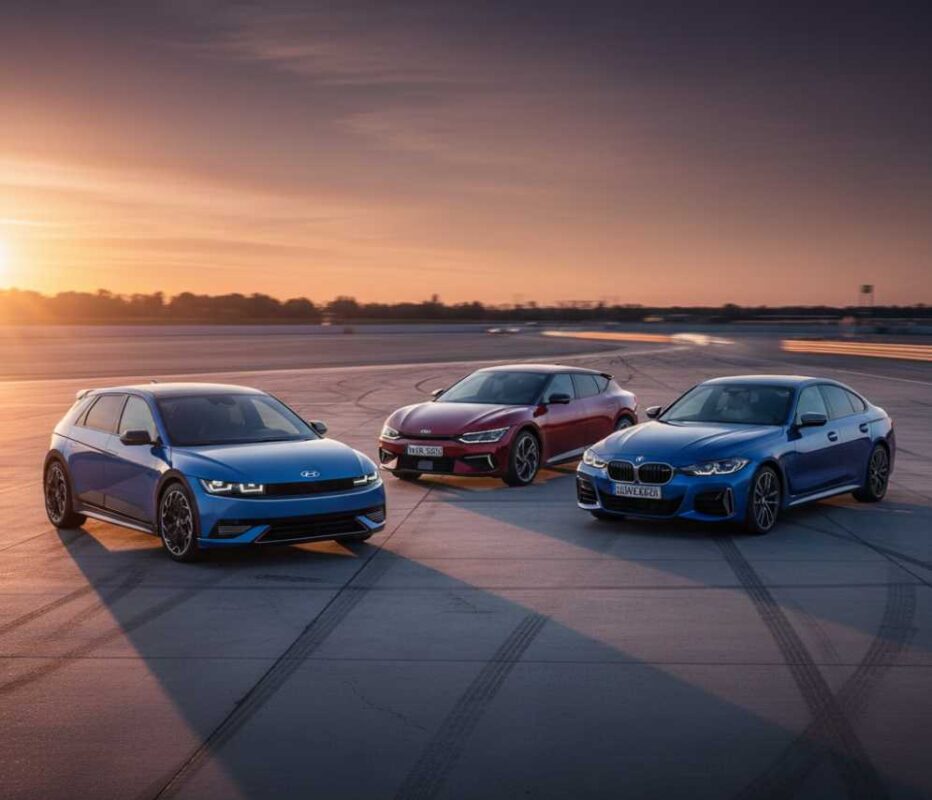
Hyundai Ioniq 5 N:
- Price: $68,705
- Horsepower: 601 hp (641 with overboost)
- EPA Range: 221 miles
- Key Highlights: Simulated gear shifts for engagement, nitrogen-cooled battery, rapid 18-minute 10-80% charging, innovative interior technology
Hyundai’s N-badged performance variant transforms the popular Ioniq platform into a driver-focused machine. With their N Grin boost activated, IONIQ 5 N can go from 0-62 mph in 3.4 seconds. Its signature feature—simulated multi-speed transmission logic with actual gear shift simulation—creates theatrical engagement absent in traditional EVs, while the nitrogen-cooled battery system enables repeated performance runs without thermal degradation. European automotive journalists increasingly rate it as the most entertaining EV to drive, despite its heavier weight compared to competitors.
You are true car enthusiast. if you remember people, not by their their name, but by the car they drive.
Kia EV6 GT:
- Price: $65,275
- 0-60 mph: 3.4 seconds
- Horsepower: Dual motors AWD
- EPA Range: 230-300+ miles (trim dependent)
- Key Highlights: Distinctive wagon design language, advanced infotainment, rapid charging (800V architecture), strong dealer support
The EV6 represents Kia’s global performance flagship, combining Korean engineering quality with a genuinely distinctive wagon aesthetic. Its 800V electrical architecture enables rapid charging capabilities, and the GT variant’s dual-motor configuration provides engagement and traction for serious driving. This Kia EV6 supports ultra-fast charging capability, taking 18 minutes to charge from 10% to 80%. The wagon form factor—increasingly rare in the American market—appeals to drivers prioritizing practicality without sacrificing performance credentials.
.
BMW i4 M50:
- Price: Approximately $70,000-$75,000
- 0-60 mph: 3.7-3.9 seconds
- Horsepower: 536 hp combined
- EPA Range: 270-315 miles
- Key Highlights: Premium interior materiality, responsive steering, adjustable suspension, traditional sports sedan proportions, heritage brand appeal
BMW’s electric performance sedan delivers the most traditionally “sports car” driving experience among affordable options, with premium interior appointments, precise steering feedback, and suspension tuning reflecting decades of sports sedan engineering. It charges fully in 10 hours and ranges up to 227-269 mi. It has Acceleration 0 – 60 Mph AUTOMATIC (sec) 3.7. Used examples at $36,000-$45,000 represent extraordinary value for premium performance.
If you are thinking of buying a hybrid car and desperately want to know how this works. We also showed this in our blog: Hybrid Electric Vehicles 2026 Buyer’s Guide: Best HEVs, Benefits, and Future Trends.
latest Articles:
- Chatting AI vs Killing AI: How OpenClaw’s Clawdbot and Moltbot Are Changing Online Conversations
- The Ad Blockers Android: Big Tech Doesn’t Want You to Know About in 2026
- Manus AI: The ‘Hand’ That Does Your Job Better Than You (Meta’s $2B Gamble Explained)
- Best Affordable Electric Sports Cars Under $100K
- Most Craziest apps that everyone needs to try in 2026
Frequently asked questions
How much does electricity cost compared to gasoline for daily commuting?
Home charging costs approximately $0.13-$0.25 per kilowatt-hour, translating to $4-$7 per 100 miles depending on local electricity rates. Equivalent gasoline consumption at current prices ($3.50/gallon, 25 mpg) costs $14 per 100 miles—roughly 2-3 times more expensive. Off-peak charging discounts available through time-of-use rate programs further reduce electricity costs by 30-40%.
What’s the practical difference between rated 0-60 times and real-world acceleration?
Manufacturer 0-60 claims represent optimized conditions with battery pre-conditioning, launch control engaged, and maximum traction available. Real-world driving experiences cooler batteries, varied grip conditions, and driving conservatively to preserve battery health. Conservative daily acceleration typically proves 0.3-0.5 seconds slower than manufacturer specifications, though still vastly superior to comparable gasoline vehicles.
Can electric sports cars handle track days and repeated performance runs?
Yes, but with important caveats. Tesla and Hyundai vehicles feature track modes optimizing thermal management and power delivery for circuit use. Battery thermal management systems prevent overheating during sustained performance, though battery power output may decrease temporarily if temperatures exceed design parameters. Most owners complete 15-20 track laps before experiencing thermal de-rating. For serious track enthusiasts, the Hyundai Ioniq 5 N’s nitrogen-cooled battery handles repeated performance events better than air-cooled competitors.
What are the main maintenance advantages of electric sports cars?
Electric vehicles eliminate oil changes (no oil required), transmission service (single-speed transmission), spark plugs, timing belts, and traditional engine cooling. Regenerative braking systems reduce brake pad wear by 40-50% compared to gasoline vehicles. Annual EV maintenance typically costs $300-$800 versus $600-$1,200 for comparable gasoline vehicles, saving 40-50% over vehicle lifespans.
“If you found this article helpful, share it with your circle and follow PingShopping on social media”
About the author