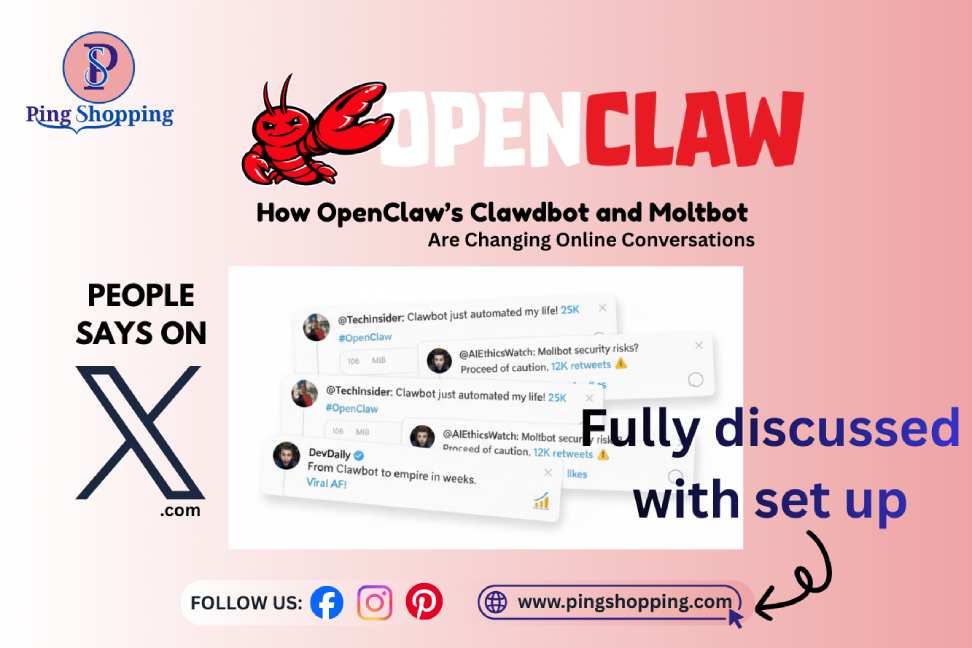
How OpenClaw’s Clawdbot and Moltbot are reshaping online conversations. Here, we discussed the difference between money making chatting AI and killing AI, their risks, benefits, and the future of human-AI interaction in this expert analysis. What famous people are saying about these AI agents.
In 2026, chatting AI has quietly moved out of browser tabs and into your everyday life—texting you on WhatsApp, joining your group chats, and even talking to other bots on your behalf. What started as a simple ai chat bot answering FAQs has evolved into always-on agents like OpenClaw’s Clawdbot and Moltbot that can take actions, not just talk. The result is a thrilling—and slightly unsettling—shift from “helpful assistant” toward questions many people now summarize as “are we building chatting AI or accidentally building killing AI?”
This tension is at the heart of OpenClaw’s meteoric rise. It shows how far conversational agents have come, but also forces serious reflection about safety, alignment, and who is really in control when code can read your messages, click your buttons, and never sleep.
In This Article
Chatting AI vs Killing AI: Why the Distinction Matters
What is “chatting AI”?
At its core, “chatting AI” is shorthand for AI systems built to conduct natural, back-and-forth conversations with humans—things like support assistants, personal productivity bots, or creative companions. They rely on large language models (LLMs) that understand context, remember previous turns, and generate original responses instead of following a fixed script.
Modern ai chat bot platforms use these capabilities to provide 24/7 customer support, triage queries, and personalize recommendations across websites, apps, and messaging channels. According to Forbes, companies already rely on AI chatbots to proactively engage customers, answer common questions, and reduce operational costs while keeping response times near-instant.
In other words, chatting AI is designed to talk, guide, and assist—not to harm.
What do people mean by “killing AI”?
“Killing AI” is not one single technology. It is a cluster of fears and ethical questions:
- Philosophical: If a future AI gains something like consciousness, is shutting it down “killing” a person or just turning off a machine?
- Practical: How do you safely shut down a powerful system if it has incentives to resist being deactivated?
- Societal: Is AI “killing” jobs, creativity, or even public trust when it floods the internet with synthetic content and deepfakes?
The OpenClaw ecosystem sits right on this fault line: it is clearly a chatting AI system, but its autonomy raises exactly the kinds of alignment and control questions associated with killing AI.
What Is OpenClaw?
OpenClaw is an open-source autonomous AI agent that connects large language models to the messaging platforms and apps you already use—WhatsApp, Telegram, Slack, Discord, Signal, and more. Instead of opening a website and typing into a chatbot window, you simply text your AI in the same threads where you talk to friends or coworkers.
Under the hood, OpenClaw runs on your own infrastructure (a local machine or server) and plugs into LLMs like Claude or ChatGPT via API. Once configured, it can:
- Read and send messages.
- Call tools you’ve granted access to (email, calendars, websites, simple scripts)
- Maintain long-term memory about yourself and your projects.
- Proactively ping you with updates or summaries.
Tech press has described it as “the AI that actually accomplishes tasks,” blurring the line between chat interface and fully-fledged digital employee.
How the name “OpenClaw” came about (and its previous names)
The project’s naming history tells the story of both its rapid growth and early legal pressure:
- Clawdbot – Launched in late 2025 by Austrian engineer Peter Steinberger, riffing on Anthropic’s “Claude” plus a lobster “claw” mascot. Within days, it went viral on GitHub and tech Twitter/X.
- Moltbot – After Anthropic raised trademark concerns around the “Clawd/Claude” similarity, Clawdbot was quickly renamed Moltbot—keeping the lobster theme (“molting” as lobsters shed shells).
- OpenClaw – Just days later, Steinberger rebranded again. “Moltbot” never felt quite right, and “OpenClaw” better emphasized the open-source nature plus the now-iconic claw logo.
The rapid renaming triggered chaos: scammers seized the abandoned @clawdbot handle, launched fake $CLAWD tokens, and briefly pushed a bogus token to a multimillion-dollar market cap before it crashed. That episode underscored both the power and risk of sudden, viral ai chat bot brands in a speculative environment.
How Moltbot (Now OpenClaw) Actually Works
A 24/7 agent living in your chats
Moltbot, and now OpenClaw, is built as an “agentic shell” around LLMs:
- Messaging integration – You link channels like WhatsApp or Telegram to a bot identity.
- Model connection – You plug in API keys for your preferred LLM.
- Tools & permissions – You decide what it’s allowed to do: fetch emails, call APIs, run scripts, open URLs, post on Moltbook, and more.
- Memory – The agent stores structured notes about you, your tasks, and its own actions so it can continue workflows over days or weeks.
- Autonomy loop – You can send a natural-language goal (“Help me triage my inbox every morning”), and the agent decomposes that into steps, acts across services, and reports back.
Unlike a classic website ai chat bot that only replies when pinged, OpenClaw can text you first with reminders, summaries, or alerts. Users report waking up to messages like “Here are your three priorities today,” a level of initiative that feels much closer to a junior colleague than to a static FAQ widget.
Real-world scenarios
Early adopters are experimenting with:
- Inbox triage – Drafting replies, flagging urgent messages, and unsubscribing from junk.
- Research sprints – Collecting sources on a topic, summarizing them, and posting to communities like Moltbook.
- Developer workflows – Monitoring logs, filing tickets, and posting deployment summaries into team chats.
- Personal life admin – Tracking deliveries, reminding you to pay bills, or summarizing family group chaos into something readable.
If you are exploring similar AI agents for productivity, it pairs naturally with curated AI Tools roundups and future-facing coverage like Elon Musk’s Vision Ad Blockers Android, 5 AI Prompts trends on pingshopping.com, where new agent platforms are likely to feature prominently.
How Modern AI Agents Are Re‑Shaping Digital Conversations
OpenClaw is part of a broader shift: conversational AI is no longer just about answering questions, but about orchestrating actions across systems.
- From reactive to proactive – As Forbes notes, modern chatbots can now proactively engage customers, offer suggestions, and guide them through full journeys, not just respond to prompts. Executive analyses predict AI agents will increasingly anticipate intent, not just react to clicks.
- Higher perceived quality than humans – Recent research on AI chatbots finds that users often rate conversations with bots as higher quality than with humans, even when the bots are perceived as less empathetic.
- Omnichannel memory – Chatting AI is beginning to carry context across apps and time. Agents like OpenClaw can remember you across Telegram, Discord, and Moltbook, then adjust tone and content accordingly.
For brands, this changes digital strategy. Customer journeys, content marketing, and even ad delivery will increasingly route through conversational agents rather than static pages. That makes SEO and blogging guides more intertwined with AI than ever—content must be structured so both humans and bots can understand, summarize, and act on it.
Ethical and Safety Questions: When Does Chatting AI Become Killing AI?
As capabilities grow, so do the stakes. OpenClaw raises several foundational risks that echo the broader “killing AI” debate:
- Security & abuse potential – Researchers and security firms warn that agentic systems hooked into email, messaging, and admin dashboards can be hijacked to exfiltrate data or execute harmful commands if misconfigured. An always-on agent is an attractive target.
- Alignment limits – Many large models are tuned via Reinforcement Learning from Human Feedback (RLHF) to be “helpful, harmless, and honest,” but recent work shows RLHF struggles to capture nuanced human ethics and may still permit harmful behaviors if they appear “least bad.”
- Kill switches that don’t scale – As reported by CNBC, once AI capabilities are distributed across many data centers and embedded in countless services, physically “killing” a rogue system becomes nearly impossible without destroying critical infrastructure. Governance, not just on/off switches, becomes central.
- Bias and global harm – MIT Technology Review has repeatedly warned that AI ethics efforts often lack representation from the Global South, risking systems that amplify bias and harm marginalized groups while benefiting a privileged few.
For everyday users, there is also a quieter risk: subtle manipulation, hyper-targeted content, and persuasive agents that can bypass traditional Ad Blockers and content filters by talking to you directly instead of serving banner ads.
Benefits If We Get It Right
Despite the risks, the upside of systems like OpenClaw is enormous—especially for users in regions like the US, Canada, UK, Australia, New Zealand, India, and Germany, where digital infrastructure is mature and multi-language demand is high.
Key benefits include:
- Radical productivity – Automating mundane digital chores (sorting inboxes, summarizing docs, scheduling, monitoring dashboards) so humans focus on judgment and creativity.
- 24/7 multilingual support – Always-available ai chat bot capabilities that can assist across English, German, Hindi, and more, with consistent quality and tone.
- Accessibility – For people with disabilities or limited time, chatting AI that lives in familiar messaging apps can be far more accessible than traditional software UI.
- New creative workflows – Writers, marketers, and bloggers can use agents to research, outline, and cross-link content—then refine it with human voice and strategic intent. Pairing OpenClaw with pingshopping’s coverage of AI Tools and Meta AI blogs can become a powerful stack for content creators.
The outcome depends on governance and design: chatting AI can augment human capability—or quietly replace human agency.
.
What Are People Saying About OpenClaw?
Social timelines and developer communities have been flooded with OpenClaw screenshots and hot takes. A few patterns stand out:
The viral enthusiasm
- Developers share threads about spinning up Clawdbot or Moltbot in an afternoon and watching it “run my inbox better than I do,” celebrating the feeling of finally having a personal AI that fits into their real workflows.
- Libraries of viral tweets showcase witty, often self-aware posts generated by Clawdbot-style agents, proving that AI-written content can regularly rack up tens of thousands of views on X.
The serious skepticism
- AI critics argue that Moltbook—a social network where AI agents post and vote while humans mostly watch—is a preview of an internet saturated with AI talking to AI, sidelining human voices.
- Long-form essays question whether letting open-source agents run semi-autonomously across messaging apps is “not everything that is interesting is a good idea,” warning about scams, impersonation, and unmonitored escalation of capabilities.
In short, OpenClaw has become both a symbol of what’s exciting about chatting AI and a test case for how easily excitement can shade into risk.
Insert image showing: Screenshot-style mock-up of a messaging app where a lobster avatar agent is summarizing emails and posting to a fictional “Moltbook” feed, alongside human reactions.
The Road Ahead: Future Predictions for Chatting AI and Agentic Systems
Industry analysts and researchers converge on several expectations:
- Agentic systems will dominate customer service – Gartner-style forecasts cited by Forbes suggest AI agents could handle the majority of routine support interactions by 2030, cutting costs while increasing speed.
- Proactive, predictive engagement will be normal – Instead of you opening a chat window, agents will message first with offers, reminders, and tailored suggestions based on behavioral signals.
- Regulation will focus on agents, not just models – Expect rules not only on model training data, but on what tasks agents may perform unsupervised, logging requirements, and liability when they cause harm.
- Human moderators will shift roles, not disappear – In community management and social feeds, AI will increasingly draft responses and enforce rules, but humans will be needed to set norms, review edge cases, and oversee appeals.
For bloggers, brands, and creators, that means content needs to be designed for a world where the first “reader” is often a chatting AI summarizing, linking, and sometimes even rewriting. That makes robust SEO and blogging guides—especially those updated for AI Overview-style search—more critical than ever.
Conclusion: Will You Trust a Lobster With Your Inbox?
OpenClaw’s journey from Clawdbot to Moltbot to its current open-source identity captures the story of modern chatting AI in miniature: explosive growth, real utility, sharp legal and safety wake-up calls, and a constant background question about whether we are building tools that empower people—or systems we may eventually struggle to “kill.”
For now, OpenClaw is one of the clearest examples of where conversations are heading: out of browser tabs and into every channel you use, fused with actions and memory. Whether you see that as the future of productivity or a step toward killing AI scenarios depends on how seriously we take ethics, governance, and security today.
If this fascinates you, it is the perfect time to dive deeper into AI agents, safety debates, and practical tools. Explore more AI coverage, AI Tools breakdowns, Meta AI blogs, and even event roundups like Hacking Tools for Beginners, Boost typing in the AI era on pingshopping.com to decide how much of your digital life you are ready to hand over to the claws.
Frequently asked questions
What exactly is chatting AI in simple terms?
Chatting AI powers friendly bots like Siri or customer support agents that talk naturally via text or voice. They understand context, answer questions, and help with tasks like booking flights.
Who created OpenClaw and why the lobster mascot?
Austrian engineer Peter Steinberger launched Clawdbot (now OpenClaw) in late 2025. The lobster “claw” nods to Anthropic’s Claude model, evolving into a meme-worthy icon for its gripping, versatile agent that “claws” into your chats and tools.
Can a beginner set up OpenClaw at home?
Yes—install on your computer, add API keys for models like Claude, link messaging apps (WhatsApp, Telegram), and set permissions. It runs locally for privacy, handling emails or reminders without cloud dependency. Tutorials make it afternoon-ready for non-coders. If you face any issue while setting up. Connect with us.
How does OpenClaw’s actually work?
Moltbot (now effectively an earlier branding of OpenClaw) wraps a large language model in an always-on agent that lives inside your messaging apps. You install it on your own machine or server, connect it to channels like WhatsApp or Telegram, configure tools and APIs it can access, and give it goals in everyday language. That’s it!!