
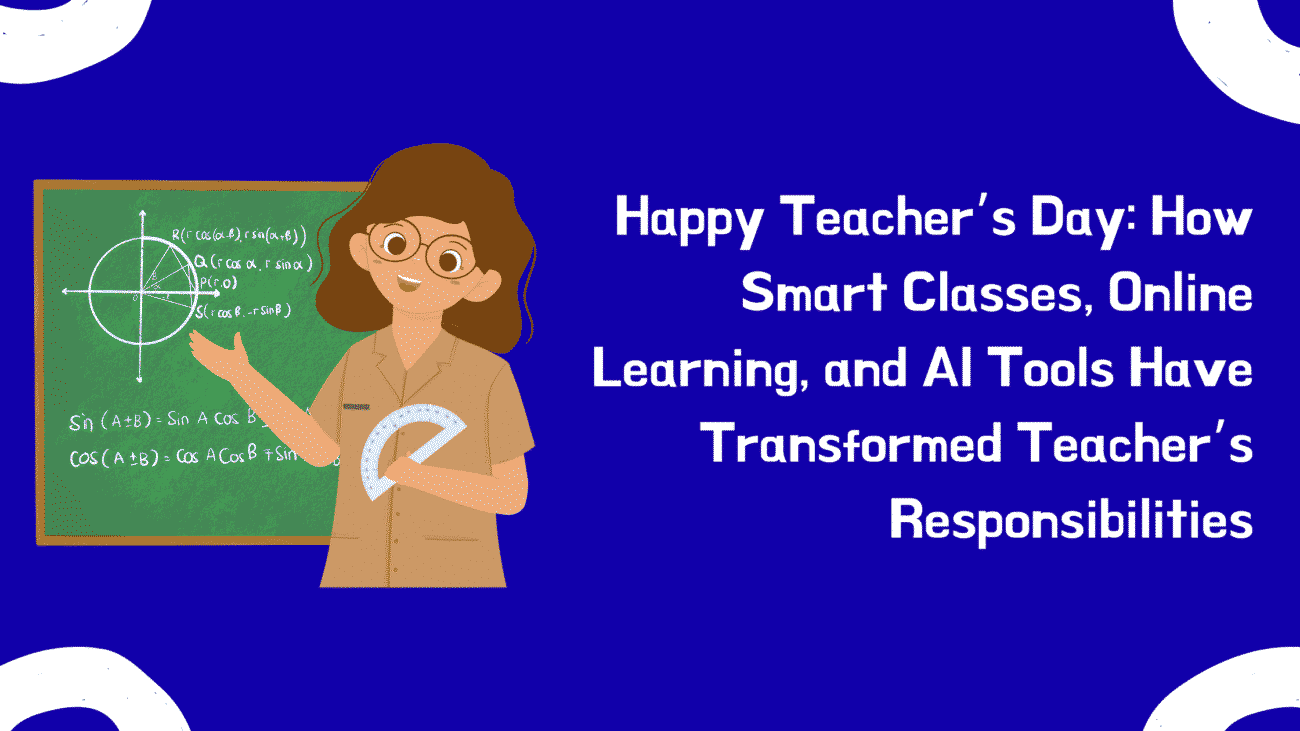

Every year on Happy Teacher’s Day, we pay tribute to the legends who sacrifice their lives in shaping our future. Traditionally, teachers used to be the sole providers of knowledge, teaching from blackboards, books, and personal interactions. But with the rise of the new digital era, the practice of education has revolutionized. With smart classrooms, e-learning sites, and artificial intelligence-driven study software, the teacher’s role has expanded and evolved in many ways. Let’s examine how technology has reshaped teachers’ roles and how educators are making sense of this new digital world.
From Chalk and Board to Smart Boards
In the past, education was a fairly monolithic experience: the teacher taught and the learner learned, in a linear sequence. But today, the classroom is entirely different. Smart boards, e-content, and virtual classrooms are substitutes or at least complements to the way it used to be done. Teachers are no longer restricted to books. Instead, they employ videos, animation, and exercises that engage multiple senses. A science lesson can now include 3D models of the solar system.

This evolution has also changed the teacher’s role. Instead of giving out information, they have become curators. They should be aware of what digital tools can clarify a particular concept, and then they should know how to keep the students active during the process.
The Challenge and Promise of Online Learning
Online learning has turned out to be one of the largest revolutions in the past few years, particularly post-global disruptions such as the pandemic. Education has actually reached every home, transcending geographical barriers. But this convenience is accompanied by its own set of challenges.
For instructors, the biggest challenge is keeping students engaged in a virtual setting. In a traditional classroom, where being present and making eye contact can maintain student focus, online learning can fall victim to distractions in the home environment. Instructors have to learn new approaches like quizzes, polls, breakout rooms, and interactive assignments—to keep students on task.
Apart from that, the assignment of tasks such as timely grading, keeping an eye on online engagement, and tracking progress has added more depth to their job. Now, teachers need to be not just teachers but also digital facilitators, managers of time, and motivators.
AI Tools: Personalizing Education
Artificial Intelligence has advanced education in many ways. Today, AI devices can learn the learning patterns of a student and suggest practice material that is adapted to their needs. For example, if a child is not good at mathematics, AI can provide specific exercises and detailed step-by-step procedures according to that student’s level.
But this is where the teacher’s role, more than ever, is so vital. Technology may suggest directions, but it’s the teacher who will ensure that these resources are used ethically, efficiently, and compassionately. Teachers remain the human touch that balances machine accuracy with emotional intelligence.
Teachers have thus turned into guides and mentors rather than fact conveyers. AI can provide answers, but teachers instill values, discipline, curiosity, and creativity.
Teachers as Guides in the Digital Age
The student today has at his or her fingertips an endless library in their pocket—the internet. From web tutorials to online discussion forums, students are able to access thousands of websites. So what is the teacher’s role amidst all this?
The solution lies in mentorship. Teaching today is less about the singular “source of knowledge” and more about guiding people through a sea of information. Teaching helps learners find the right sources, use knowledge effectively, and maintain a lifelong desire for learning.
Beyond Academics
AI and web platforms can provide a variety of information, but they can’t build empathy in children. This can be done only by the teachers, and ensure that they acquire both smartness and become good citizens. In virtual classrooms, it typically entails discussing cyber manners, encouraging polite communication, and educating critical thinking in order to sift through the information overload of social media. These are considerably more than academic responsibilities and highlight the life coach that the teacher now has.
Latest informative articles
- Chatting AI vs Killing AI: How OpenClaw’s Clawdbot and Moltbot Are Changing Online Conversations

- Manus AI: The ‘Hand’ That Does Your Job Better Than You (Meta’s $2B Gamble Explained)
- Elon Musk’s Vision, Mission, and Prediction
- Elon Musk and Nikhil Kamath: A Transformative Conversation
- How Typing Can Boost Your Productivity in this AI Era





Looking Ahead: The Teacher of Tomorrow
The future classroom would be a combination of physical presence and digital technology—a hybrid model with technology and human interaction coexisting. Teachers will be central, but their role will continue to expand. They will no longer only be teaching, but also be the curators of resources, facilitators of experiences, character builders, and the bridge between the students and technology.
Conclusion: A Salute to Teachers’ Day
On this Teacher’s Day, one must appreciate that teaching today is far more complicated and demanding than ever before. From mastering the smart boards and online courses to enabling the students to utilize AI tools responsibly, teachers are constantly learning to meet the demands of the digital age.
But at the center of it all remains the same: to create curiosity, to trigger imagination, to inculcate values. Technology may change tools of the trade, but the art of teaching, the human element immortal. Let’s then toast to the countless instructors of the past and present who keep on teaching us both through chalk and smart boards in equal measure, and prove to us that no device can ever substitute for the powers of a dedicated teacher.
“If you found this article helpful, share it with your circle and follow PingShopping on social media”
About the author