

Is It Really Possible to Earn 1 Cent/Sec?
What if you could earn 1 cent per second — effortlessly? “Is this really possible through mindset, action, and modern tools and strategies?
The answer is “Yes” if you have strong willpower and passion, a mindset, a strategy, patience, and a good acknowledgment. One crucial thing to note is that it’s not an overnight vision if you don’t have a huge amount. This article will dive into the core ideas and functionalities of wealth creation from almost zero wealth. What makes you put forward to your success is the strategy, mindset, and actions between what you have and have nots.
In This Article
The Core Idea: Mindset + Strategy + Law of Attraction + Practical Action (Digital + Active + Passive Income)
The annual equivalent of earning 1 cent every second is approximately $315,360.
Based on global income distribution data from 2021, the average annual income for the top 1% of global earners is nearly $749,000. The global top 1% represents over 81 million people (based on a world population of 8.1 billion), and their average income is significantly higher than $315,360 per year.
Therefore, the number of people in the world who earn more than 1 cent per second is estimated to be in the tens of millions, a subset of the world’s top 1% of earners. So, aren’t you thinking that it is a huge number and you can’t enter into the club of 1-cent-per-second earners? Research and studies show that one can get into this club with significant enthusiasm and earning passion.
The concept of earning 1 cent per second might sound modest at first glance, but when you understand the mathematics behind it, the reality becomes extraordinary. One cent per second translates to $0.60 per minute, $36 per hour, $864 per day, and an astounding $315,360 per year—all without lifting a finger. This isn’t just about money; it’s about transforming your relationship with wealth, understanding the universal laws of wealth creation that govern financial abundance, and building systems that generate income while you sleep.
In a world where financial freedom seems elusive to many people, the pathway to consistent, automatic wealth creation lies in the proper mindset and strategic actions. This comprehensive guide will reveal the proven principles and strategies from the world’s most influential wealth-building books, combined with practical strategies that work in today’s modern world and digital economy, especially for audiences seeking to manifest money and create permanent prosperity.
Understanding the Power of Per-Second Earnings
Before diving into the laws and strategies, let’s comprehend what earning 1 cent per second truly means. In a year with 31,536,000 seconds, this seemingly small amount compounds into life-changing income. The beauty of this concept lies not in working harder but in creating systems and adopting mindsets that allow money to flow to you continuously.
The mathematics of micro-earnings reveals a profound truth: wealth isn’t always about landing one massive opportunity; it’s about creating consistent, scalable streams of income that compound over time. When you break down your financial goals into per-second, per-minute, and per-hour targets, you transform an overwhelming objective into manageable, actionable steps.
This approach aligns perfectly with the modern digital economy, where passive income streams, automated businesses, and strategic investments can generate revenue 24 hours a day, 365 days a year. Whether you’re in Mumbai, New York, London, or Sydney, the principles remain universal, though the application may vary based on local opportunities and cultural contexts. Of course, it’s worth mentioning that if you are looking for an overnight success through gambling, investing, trading, etc., the article is not for you. Earning 1 cent per second needs a strategic implementation and execution of your plans, and then creating a channel or system that grows steadily. It needs time, passion, dedication, experimentation, patience, and a little bit of expertise.
The Psychology Behind Money and Wealth Creation
The brain is the factory, thoughts and ideas are the operators, initial investment, effort, time, dedication, and expertise are the fuels, implementation, execution, and leading are the currency to keep the whole system on track, and finally, Money is the product which is essential for running the whole system including survival of your vital life in the world. It’s worth mentioning that the deepest belief and mindset with the most significant focus and a little bit of manifestation play a key role in achieving this milestone of 1 cent per second. Depression will come in the midway, sometimes the system breaks, perhaps you will lose hope and beliefs, there might be an external and natural obstacle, you might lose the vital energy to run and work on the system – you have to consider all the things. That’s natural, and everybody has gone through the points who are successful or ultra successful. However, there is a positive vibe for you – the psychology of money, as research in behavioral finance demonstrates, reveals that financial success has less to do with intelligence and more to do with behavior. Your thoughts, beliefs, and subconscious programming around money create invisible barriers or open floodgates to abundance.
Understanding your money mindset begins with recognizing inherited beliefs. Many people unconsciously adopt their parents’ attitudes toward wealth—scarcity thinking, fear of loss, guilt about abundance, or beliefs that money is inherently evil. These subconscious patterns, formed in childhood, continue to sabotage financial success in adulthood unless consciously reprogrammed. – So, never enter into the group of such people. If you think it’s a myth, it’s a myth, and you will get success. But if you think it’s real – it will be real, and somehow you will be stuck in the circle of unsuccessful people. So, decision, mindset, and belief play a key role indirectly in your subconscious algorithm. That’s why you have to learn how to play with the conscious mind in the front and the subconscious mind in the back.
An abundance mindset involves daily practices: gratitude for current resources, visualization of desired financial outcomes, affirmations, manifestation, reprogramming limiting beliefs, and consistent actions aligned with wealth-building goals will eventually lead to the entrance of success. Neuroscience also confirms that repeated thoughts and behaviors create neural pathways, literally rewiring your brain for prosperity. For long-term success and staying wealthy till death, you must follow the same rule that the world often observes in the case of Warren Buffett.
In Indian culture, the concept of “Lakshmi consciousness – often called the prayer for DhanaLakshmi“—inviting the goddess of wealth through positive vibrations—parallels Western manifestation principles. Across cultures, the truth remains: your internal state of wealth consciousness precedes external financial manifestation. That really works in the right attitude and manner with proper internal vibrations.
Also Read:
Top 10 costly money pitfalls to avoid in 2025
The Baniya Money Code: Lessons From India’s Silent Wealth Creators
Money Habits That Can Destroy Millionaires in a Single Night
5 Life-Changing Books to Transform Your Finance, Mindset, and Personal Growth
Universal Laws Governing Financial Abundance
The Law of Attraction for Money
The Law of Attraction states that like attracts like—your abundant thoughts, feelings, and beliefs incentivise and convert corresponding efforts into your reality. When applied to money, this means your consistent vibration around wealth determines what flows into your life. In a nutshell, the law of attraction means your emotion consistently tries to attract that abundance through mindset, belief, effort, actions, and execution with consistency.
This isn’t something everybody messed up with the feeling. This isn’t magical thinking; it’s about focused attention and the Reticular Activating System in your brain, which filters information based on what you deem important. When you maintain wealth consciousness, you notice opportunities, connections, and resources that were always present but previously invisible to you.
The most important factors of the law of attraction are:
- First: Focus
- Second: Actions
- Third: Executions
- Fourth: Consistent Patience
- Fifth: Have Faith
- Sixth: Keep on Track and Keep growing & Improving
Practical application involves daily visualization of your financial goals as already achieved, feeling the emotions of abundance, speaking affirmations with conviction, and taking inspired action when opportunities present themselves. All these things together called Manifestation through the law of attraction.
Also Read:
Best diet plan for weight loss in 30 days
Weight Loss diet plan with high fiber and protein, 10 super foods in a healthy way.
The Law of Action and Reciprocity
While mindset is foundational thought and feeling, proper action and execution are vitally essential. The Law of Action reminds us that thoughts without execution remain fantasies. Every financial breakthrough requires physical steps—launching a business, creating content, making investments, or providing services. Customer satisfaction, usability, essentiality, and everlastingness are the most important things to be considered while starting a startup or business or service.
The Law of Reciprocity teaches that giving creates circulation we often call “Give and Take”. Money is energy that must flow; only advertising creates flows in the human mind but strategic action with a little bit of human psychological behavior and attitude creates a long long-lasting path to generosity—donating to causes, mentoring others, or providing free value—opens channels for greater abundance to return. That’s the reciprocity that circulates over and over again if strategically applied.
In practical terms, this means balancing spiritual practices like meditation and affirmations with concrete business strategies, skill development, networking, and consistent effort toward income-generating activities. If any newborn brand can’t create instincts in people to use the brand, it should go through classical or conventional ways to build a strong brand. Before building a strong brand that’s widely recognized, every businessman or entrepreneur must practice the rules of reciprocity. That’s the way how rules of reciprocity work.
The Law of Cause and Effect
Every financial result traces back to specific causes—decisions, habits, investments, and actions. If you want different financial outcomes, you must implement different inputs. This law eliminates victimhood and empowers you to engineer your desired results through intentional choices.
Tracking your financial behaviors reveals patterns. Do you spend impulsively? Avoid investing? Undercharge for services? Each habit creates predictable effects. Changing the causes—budgeting consciously, learning investment principles, valuing your expertise—inevitably changes the effects. To become the most powerful businessman or entrepreneur within, continued learning and experiencing is essential. Without the self-evolution and self-upgradation, it’s not possible to stay on track and keep going and growing. The cause and effect are nothing but what causes the effect, whether good or bad. Good causes create good effects that help you grow, and bad causes create bad effects that make you stop or suffer the burden of financial losses.
The Law of Persistence and Compound Growth
Little consistent actions compound into extraordinary results over time. One plus one makes two, two plus two makes four, four plus four makes eight, and so on and on. This principle applies to savings, investments, skill development, trust and audience building, and finally applies to wealth accumulation. The person who saves $100 monthly starting at age 25 accumulates far more wealth by retirement than someone saving $500 monthly starting at age 45, due to compound interest. “Compounding is the 8th wonder of the world,” as once said by Albert Einstein. The saying is great and 200% valid. However, it’s not justified whether exactly what Einstein said or not.
Similarly, creating one piece of valuable content daily, making ten sales calls weekly, or investing consistently regardless of market conditions produce exponential long-term results that sporadic massive efforts cannot compete.
Share it with your friends and relatives
How the World’s Greatest Wealth Books Help You Earn 1 Cent Per Second
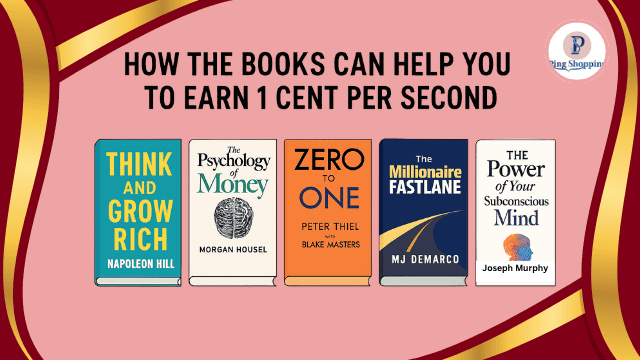
Think and Grow Rich by Napoleon Hill
Napoleon Hill spent 25 years studying 500 successful individuals, including Andrew Carnegie, Henry Ford, and Thomas Edison, distilling their secrets into 13 principles of wealth creation. Hill discovered that riches begin with thought—definite desire combined with unwavering faith that manifests into a material equivalent.
Hill’s core message: Your burning desire, backed by specialized knowledge, organized planning, and persistence, activates forces that conspire to bring opportunities, people, and circumstances necessary for achieving your financial goals. The mastermind principle—surrounding yourself with supportive, ambitious individuals—multiplies your intelligence and resources exponentially.
For modern wealth seekers, Hill’s teachings translate into clarity of purpose (knowing exactly how much money you want and by when – “How much” will trigger your actions and executions, and “By when” will trigger your momentum and efficiency), daily affirmations that program your subconscious, continuous learning in your active field, decisive action despite fear, and building strategic relationships with those who share your vision. His auto-suggestion technique—repeating wealth affirmations while visualizing success—remains one of the most powerful manifestation tools available.
Hill emphasizes that thoughts are things with magnetic power that attract enormous energy to incentivize the actions and achieve a goal. When you think about wealth with emotion and conviction, you activate the creative forces of your subconscious mind, which works tirelessly to attract resources, ideas, and opportunities. The subconscious mind is running and working in the background through rewiring the neural pathways to transfer the signals throughout the body system as much as possible. The secret he alludes to throughout the book is that desire, when persistent and backed by definite plans, becomes an irresistible force that transforms circumstances. Modern practitioners of Hill’s principles report breakthrough results when combining his mental techniques with today’s digital wealth-building opportunities, creating businesses and income streams that previous generations couldn’t imagine. No matter how competitive the market is, the principles still work in a mysterious way.
Also Read:
Top 10 costly money pitfalls to avoid in 2025
The Baniya Money Code: Lessons From India’s Silent Wealth Creators
Money Habits That Can Destroy Millionaires in a Single Night
5 Life-Changing Books to Transform Your Finance, Mindset, and Personal Growth
The Psychology of Money by Morgan Housel
Morgan Housel revolutionizes financial thinking by revealing that doing well with money has little to do with intelligence and everything to do with behavior. Financial success is not a hard science governed by formulas but a soft skill shaped by psychology, emotions, and personal experiences.
Housel’s central insights include understanding that no one is crazy—everyone’s financial decisions make sense based on their unique life experiences. Someone who experienced market crashes approaches investing differently than someone who experienced bull markets. Luck and risk are siblings; outcomes often depend on forces beyond our control, so judging success or failure requires humility.
The concept of “enough” stands as Housel’s most powerful teaching. Many wealthy individuals destroy their lives chasing more because the goalpost constantly moves. True wealth means knowing when you have sufficient resources and resisting the dangerous game of social comparison. Billionaires who commit fraud despite having hundreds of millions prove that without a sense of enough, no amount satisfies. When you are above the basic standard of living, your hierarchy of needs (by Maslow’s theory of motivation) will go higher. After achieving a certain amount of wealth and reputation, people go to the highest stage called “Self-Actualization”. In this stage, people act in an unaccustomed way that you can’t even imagine. So, the concept of enough is a never-ending lust for wealth. So, multimillionaires and billionaires also learn the concept of when the cease and when to continue to safely maintain their present wealth status.
Housel argues that real wealth is invisible—it’s the cars not purchased, the watches not worn, the lifestyle inflation avoided. Wealth is freedom, control over your time, and the ability to wake up and do what you want. The greatest intrinsic value of money is the autonomy it provides—choosing how to spend your days rather than being enslaved to obligations.
For practical application, Housel recommends reasonable over rational financial plans, recognizing that humans are not calculating machines. Save not for specific goals but for the unexpected—life’s greatest expenses are unpredictable. Room for error, margin of safety, and long-term thinking beat aggressive optimization every time. Compounding works magic when you give it time; the key is staying in the game long enough for compounding to reveal its power. This requires avoiding stupid mistakes that cause permanent capital loss more than seeking brilliant investments.
Zero to One by Peter Thiel
Peter Thiel, PayPal co-founder and early Facebook investor, presents a contrarian framework for creating wealth: building monopolies through innovation rather than competing in crowded markets. He also funded companies like SpaceX and LinkedIn, and started the Thiel Fellowship, which encourages young people to put learning before university. His central thesis distinguishes between horizontal progress (copying things that work, going from 1 to N) and vertical progress (creating something entirely new, going from 0 to 1).
Thiel argues that competition is for losers—capitalism and competition are opposites. Under perfect competition, no company makes a meaningful profit. To build lasting wealth, create a monopoly by solving problems ten times better than existing solutions, targeting small specific markets initially, and dominating them before expanding.
His contrarian question—”What important truth do very few people agree with you on?”—reveals the mindset required for breakthrough wealth creation. Following consensus leads to mediocre results; extraordinary success requires seeing opportunities others miss, believing in your vision despite skepticism, and executing with conviction.
For personal wealth building, Thiel’s principles translate into finding niches where you can be incomparable rather than competing on price or features, investing in revolutionary technologies or business models rather than incremental improvements, starting with a small market you can dominate completely, building proprietary technology or processes that create genuine barriers to competition, and thinking long-term about building lasting assets rather than quick wins.
Thiel emphasizes timing—great ideas too early or too late both fail. Strategic thinking about when markets are ready for innovation separates successful entrepreneurs from brilliant failures. He also stresses that sales matter as much as product; even the best offering fails without an effective distribution strategy. This counters the myth that “build it and they will come”—deliberate marketing, sales, and positioning determine success.
His seven questions for business success—engineering breakthrough, timing, monopoly potential, team quality, distribution channel, durability, and opportunity uniqueness—provide a rigorous framework for evaluating any wealth-building venture, applicable whether starting a tech company in Bangalore or a service business in Chicago.
The Millionaire Fastlane by MJ DeMarco
MJ DeMarco shatters conventional financial advice with his radical critique of the “Slowlane”—the traditional path of saving 10-20% of your income, investing in index funds, and hoping to retire wealthy at 65. He argues this plan steals your youth, trades time for money inefficiently, and depends on variables outside your control (market performance, inflation, longevity).
DeMarco introduces the Fastlane wealth equation: Wealth = Net Profit + Asset Value, where Net Profit = Units Sold × Unit Profit, and Asset Value = Net Profit × Industry Multiplier. This formula reveals why business ownership and scalable systems create wealth faster than employment or stock market investing—you control multiple variables simultaneously.
The Fastlane mindset shifts from consumer to producer, from demanding value to providing it, from trading time for money to building systems that generate income independently of your hours. DeMarco emphasizes the five commandments for Fastlane businesses: need (solving genuine problems), entry (significant barriers to entry), control (ownership of the system), scale (reaching unlimited customers), and time (decoupling income from time invested).
For practical application, DeMarco advises identifying problems people desperately want solved, creating systems that serve many rather than trading time for dollars, building assets that appreciate and can be sold for multiples of annual profit, focusing on impact over income (helping millions of people generate millions of dollars), and maintaining a producer rather than consumer mentality in all financial decisions.
He cautions against fake wealth—expensive possessions bought on credit that create the appearance of prosperity while destroying actual financial freedom. Real wealth consists of family, fitness, and freedom—the 3Fs that matter most. Money serves as a tool to enhance these dimensions, not an end in itself.
DeMarco’s most controversial teaching challenges traditional compound interest worship, demonstrating that young entrepreneurs can leverage business growth to create in five to ten years what traditional retirement planning requires forty years to achieve. His message empowers action-takers willing to build, risk, learn, and execute rather than passively hoping market returns will eventually provide freedom.
For digital-age wealth seekers in India and globally, DeMarco’s principles align perfectly with online business opportunities—creating digital products, building audiences, offering services at scale, and leveraging technology to serve thousands or millions of customers with minimal incremental cost per unit.
The Power of Your Subconscious Mind by Joseph Murphy
Dr. Joseph Murphy’s classic reveals that your subconscious mind—the powerful creative mechanism operating below conscious awareness—determines your financial reality. Every belief, thought, and emotion impressed upon your subconscious manifests as corresponding external circumstances, including wealth or poverty.
Murphy teaches that poverty is a mental disease, not a virtue, and prosperity is your spiritual birthright. The subconscious accepts whatever you consistently feel and believe as true, then works tirelessly to materialize those convictions. If you harbor beliefs that money is evil, scarce, or reserved for others, your subconscious ensures your reality reflects those limitations.
His practical techniques for manifesting money include affirmations repeated with feeling until accepted by the subconscious (“Money flows to me easily and continuously,” “I am prospering beyond my dreams”), visualization exercises where you vividly imagine checking large bank balances or receiving unexpected income, sleeping with wealth consciousness by affirming abundance as you drift to sleep when the subconscious is most receptive, and releasing negative associations with money by affirming its positive nature as a tool for good.
Murphy emphasizes that the subconscious responds to belief and feeling, not intellectual reasoning. Simply repeating affirmations mechanically produces little result; infusing them with genuine conviction, gratitude, and positive emotion activates the creative power. He advises against affirming specific amounts you cannot believe, instead building belief gradually with amounts that feel exciting but achievable, then expanding as faith grows.
For manifestation India and global practitioners, Murphy’s techniques integrate beautifully with traditional spiritual practices—meditation to quiet the conscious mind and access subconscious programming, gratitude rituals that create abundance vibration, and service to others that opens channels for receiving. His teaching that wealth consciousness must precede wealth manifestation explains why lottery winners often return to poverty—external money cannot sustain itself without internal transformation.
Murphy also addresses the importance of not resenting others’ wealth—each person’s success testifies to universal abundance principles that work equally for everyone who applies them. Celebrating others’ prosperity rather than feeling jealous or bitter aligns your vibration with wealth, magnetizing similar experiences to you.
Also Read:
Top 10 costly money pitfalls to avoid in 2025
The Baniya Money Code: Lessons From India’s Silent Wealth Creators
Money Habits That Can Destroy Millionaires in a Single Night
5 Life-Changing Books to Transform Your Finance, Mindset, and Personal Growth
Practical Strategies for Earning 1 Cent Per Second
Building Passive Income Streams
Passive income—earnings requiring minimal ongoing effort after initial creation—forms the foundation of per-second wealth. Multiple streams create stability, while each stream compounds over time. It’s clear that achieving the milestone of 1 cent per second is not possible without passive income because you never reach the goal of 1 cent per second by actively working if you are not the CEO or MD or a higher official of a big company. So it’s only possible by doing business or creating a system that earns money for you while you sleep.
Some of the ways that can help you achieve the milestone:
Affiliate Marketing: Promote products or services you trust, earning commission on sales generated through your unique links. Select niches aligned with your expertise, create valuable content reviewing or comparing products, build audience trust through authentic recommendations, and diversify across multiple affiliate programs. Successful affiliate marketers in 2025 focus on SEO-optimized content, email marketing, and social media influence. In India, affiliate opportunities span from Amazon India to niche programs in finance, technology, health, and education. There are so many affiliate marketing platforms available. Some of the most common platforms are Amazon Associates, ShareASale, ClickBank, CJ Affiliate, etc
Digital Products: Create once, sell infinitely. Ebooks, templates, online courses, printables, software tools, and membership sites require upfront time investment but generate ongoing revenue with 80%+ profit margins. The digital products market is projected to reach $850 billion by 2027, with creators worldwide earning six to seven figures annually from information products. A well-designed online course priced at $97 selling to just 3,000 students generates $291,000 in revenue—approaching the per-second earning goal. To achieve $100,000 quarterly, you need only 10,000 sales of a product priced at $10, or 1000 sales of a product priced at $100, or 20,000 sales of a product priced at $5, or only 100 sales of a product priced at $1000. That’s how one can hit the earning milestone of 1 cent per second.
Content Monetization: YouTube ad revenue, blog advertising, podcast sponsorships, and Medium’s Partner Program pay creators for producing valuable content. While requiring consistency and audience building, successful content creators generate substantial passive income. A YouTube channel with 100,000 subscribers might earn $2,000-$5,000 monthly from ads alone, plus sponsorships, affiliate commissions, and product promotions, multiplying income several times over.
Investment Income: Dividend stocks, real estate investment trusts (REITs), peer-to-peer lending, and high-yield savings accounts generate passive returns. While requiring initial capital, strategic investing creates true per-second earnings—dividends depositing into your account whether you’re sleeping, traveling, or working on other ventures. A $300,000 dividend portfolio yielding 7% annually generates $21,000 in passive income, approximately $0.67 per second when spread across the year. Also remember, instead of putting all your eggs into one basket, divide and distribute your eggs and put them into different baskets. This concept of managing wealth is given by Sir Warren Buffett.
Note: We wouldn’t recommend anybody who doesn’t have enough money to invest in any platform, whether it’s a dividend portfolio, crypto trading, intraday trading, stock market, etc.
Leveraging Automation and Technology
Modern technology enables solo entrepreneurs to operate businesses generating significant revenue with minimal ongoing labor through automation tools.
Email Marketing Funnels: Automated sequences nurture leads into customers while you sleep. A well-designed funnel captures email addresses through free, valuable content, delivers a series of educational emails building trust and demonstrating expertise, presents relevant product offers at optimal moments, and converts subscribers into buyers automatically. Email marketing consistently delivers the highest ROI of digital marketing channels, with every $1 spent generating an average $42 return.
Sales Automation: Customer relationship management (CRM) systems, chatbots answering common questions, automated booking systems for consultations, and payment processing integrated with digital product delivery eliminate manual tasks. These systems enable one person to serve hundreds or thousands of customers with the responsiveness of a large team.
Content Scheduling: Platforms allowing batch content creation and scheduled publication let creators produce weeks or months of content in concentrated sessions, then maintain a consistent presence automatically. This strategy liberates time for higher-value activities while maintaining audience engagement.
AI-Powered Tools: In 2025, artificial intelligence assists with content creation, customer service, data analysis, and marketing optimization, dramatically increasing solo entrepreneur productivity. While maintaining authentic human connection, strategic AI integration amplifies output and income potential. Day by day, AI-powered automation is increasing; if you are not one of them, you can’t change the game of your competitors.
Creating Scalable Digital Businesses
Scalability—serving exponentially more customers without proportionally increasing effort—separates per-second earners from time-traders.
Software as a Service (SaaS): Subscription-based software solving specific problems generates recurring revenue, growing with customer acquisition. While technically challenging, even non-programmers can partner with developers or use no-code platforms to launch SaaS products. Monthly recurring revenue compounds as the customer base expands, creating predictable income scaling far beyond time investment.
Membership Communities: Exclusive groups offering ongoing value—education, networking, resources, support—for monthly or annual fees generate reliable recurring income. A membership site with 500 members at $50 monthly produces $25,000 monthly ($300,000 annually), approaching the per-second goal with a relatively modest audience.
Online Course Platforms: Comprehensive courses teaching valuable skills command premium prices and serve unlimited students. Creating a $500 course selling to 600 students annually generates $300,000+ in revenue from a single product created once and updated periodically. Platforms like Teachable, Thinkific, and Kajabi handle payment processing, content hosting, and student management automatically.
Print-on-Demand and Dropshipping: E-commerce models eliminating inventory management and fulfillment logistics allow entrepreneurs to focus on marketing and customer acquisition. Products ship directly from suppliers to customers, with business owners earning profit margins without touching physical goods.
The 30-Day Manifestation and Action Challenge
Combining mindset mastery with strategic execution accelerates results exponentially. This integrated approach addresses both internal programming and external systems.
Morning Wealth Ritual (15 minutes daily): Begin each day by programming your subconscious for abundance. Five minutes of gratitude—listing everything you appreciate, including current financial blessings, no matter how modest. Five minutes of visualization—vividly imagining your life with the desired income, feeling emotions of financial freedom. Five minutes of affirmations—speaking wealth declarations with conviction: “I am a money magnet,” “I’m the winner,” “I’m benefited every day and growing exponentially,” “Abundance flows to me from multiple sources,” “I provide immense value and receive abundant compensation.”
Daily Wealth-Building Action (minimum 3 hours): Dedicate focused time to income-generating activities—creating content, building products, marketing services, developing skills, networking with potential clients or collaborators. Consistency compounds; one hour daily accumulates to 365 hours yearly, sufficient to build substantial income streams.
Evening Reflection and Adjustment (10 minutes): Review the day’s progress, celebrate wins however small, identify improvements, and plan tomorrow’s priority actions. This practice develops the self-awareness and adaptability essential for sustained success.
Weekly Progress Audit: Each week, assess financial metrics—income generated, audience growth, product development progress, and networking connections made. Adjust strategies based on results, doubling down on what works and eliminating what doesn’t.
Geo-Specific Strategies for India
India’s rapidly growing digital economy offers unique opportunities for wealth creation aligned with per-second earning goals.
Digital Services Export: Indian professionals offering services to US, European, and Australian clients leverage favorable exchange rates, earning dollars, pounds, or euros while maintaining rupee-based living costs. Freelance writing, graphic design, software development, virtual assistance, and social media management command international rates, creating substantial rupee income.
Indian Affiliate Programs: Beyond global platforms, India-specific programs like Amazon India Associates, Flipkart Affiliate, and specialized financial services, education, and technology products offer lucrative opportunities targeting the world’s second-largest internet user base.
Online Education for Indian Students: Creating courses addressing entrance exam preparation (JEE, NEET, UPSC), skill development for emerging industries, regional language content, and practical skill training taps massive demand from India’s education-focused population.
Cultural Consultancy: As Indian businesses expand globally and Western companies enter Indian markets, cultural expertise becomes increasingly valuable. Consultants bridging these worlds command premium fees for relatively modest time investment.
Share it with your friends and relatives:
Overcoming Common Obstacles to Financial Success
Breaking Through Limited Beliefs
Identifying and transforming subconscious wealth blocks is foundational work. Common limiting beliefs include: “Money doesn’t grow on trees,” “Rich people are greedy,” “I’m not smart/talented/connected enough to be wealthy,” “Making money requires sacrificing integrity,” and “Financial success isn’t spiritual.”
These beliefs, often absorbed in childhood, create invisible misbeliefs about earning potential. Transformation requires conscious awareness of these patterns, questioning their validity with adult reasoning, replacing them with empowering alternatives through affirmation and visualization, and gathering evidence of the new belief’s truth through small financial wins that build momentum. Always stay away from myths and rumours spread by common people. Don’t judge yourself by listening to your surrounding people, not even your parents(if you are content and confident with your vision, actions, and goals).
Defeating Procrastination and Perfectionism
Many aspiring entrepreneurs delay launching businesses, creating products, or marketing services while waiting for perfect conditions, complete knowledge, or ideal circumstances. This perfectionism disguises fear of failure, fear of judgment, and fear of inadequacy, and you stay away from taking actions and responsibilities.
The antidote is imperfect action—launching before feeling ready, learning through doing rather than endless preparation, embracing failure as feedback refining your approach, and recognizing that every successful person’s first attempts were mediocre. The wealth you desire awaits on the other side of the actions you’ve been avoiding.
Navigating Family and Cultural Resistance
In both Indian and Western contexts, pursuing non-traditional wealth-building paths often triggers family concern or criticism. Traditional career expectations, risk aversion, and limited exposure to entrepreneurial success create well-meaning but limiting advice from loved ones.
Strategies for navigating this challenge include clearly communicating your vision and specific plans demonstrating strategic thinking rather than reckless risk-taking, setting boundaries around whose opinions influence your decisions, seeking mentorship and community from those succeeding in your chosen path, and letting results speak—small wins gradually convert skeptics into supporters.
Maintaining Consistency
The journey from financial struggle to per-second earnings rarely follows a linear path. Setbacks and periods where effort seems fruitless test commitment and faith.
Sustaining momentum requires connecting daily actions to compelling long-term vision, tracking leading indicators (actions taken, content created, skills developed) rather than only lagging indicators (money earned), celebrating small wins, maintaining positive momentum, and learning from setbacks without interpreting temporary failure as permanent identity.
The Compound Effect of Small Financial Decisions
While the goal is earning 1 cent per second ($315,360 annually), reaching this target involves numerous small decisions compounding over time. Saving $10 daily and investing it at 8% annual returns accumulates to $17,889 in five years, $47,115 in ten years, and $179,073 in twenty years—purely from the compound effect of modest daily savings.
Similarly, learning one new marketable skill yearly, creating one piece of evergreen content weekly, or making one strategic business connection monthly compounds into an extraordinary career and income transformation over several years.
The magic isn’t in dramatic gestures but in consistent small actions aligned with wealth-building principles. One sales call might not change your life; one daily call for a year generates 365 opportunities, likely converting to significant client revenue. One YouTube video might not launch a channel; one weekly video for two years creates 104 videos establishing authority and attracting a substantial audience.
Building Your Wealth Frequency and Money Magnet Mindset
Beyond tactics and strategies, sustainable wealth flows from becoming the type of person who naturally attracts and maintains abundance. This transformation involves identity-level change—seeing yourself as inherently worthy of wealth, valuable to others, capable of creating multiple income streams, and responsible for your financial destiny.
Practices that cultivate wealth frequency include daily gratitude, elevating your emotional vibration to match abundance, visualization, creating neural patterns of success before external manifestation, affirmations reprogramming subconscious limitations, generous giving that demonstrates trust in continuous flow, continuous learning expanding your capacity to create value, and surrounding yourself with prosperity-minded individuals whose energy elevates yours.
Money magnet mindset isn’t about desperation or obsession with money but relaxed expectation of abundance, confidence in your ability to generate income, openness to receiving from unexpected sources, and trust that opportunities flow to you naturally.
The Road from $0.01 to $1 Per Second
Once systems generate 1 cent per second, the same principles scale to 10 cents, then $1 per second—$31.5 million annually. While this level requires either massive audience reach, premium pricing, or significant capital leverage, the pathway remains consistent: providing extraordinary value at scale, building automated systems maximizing profit per transaction, investing profits into appreciating assets generating additional passive income, and continuously expanding skills, networks, and strategic thinking. The model, or the system, or the business must be diversified strategically to achieve the goal of 1 dollar per second.
Millionaires and billionaires aren’t fundamentally different from you—they simply applied wealth-building principles with greater consistency, duration, and scale. Every fortune began with a decision, followed by action, refined through failure, and sustained through persistence. Building trust and authority play a crucial role in achieving this type of financial success.
Also Read:
Top 10 costly money pitfalls to avoid in 2025
The Baniya Money Code: Lessons From India’s Silent Wealth Creators
Money Habits That Can Destroy Millionaires in a Single Night
5 Life-Changing Books to Transform Your Finance, Mindset, and Personal Growth
Your Journey to Financial Freedom Begins Now
Earning 1 cent per second is not merely a financial goal but a symbol of freedom—the ability to generate income continuously regardless of your immediate activities, to wake up and choose how to spend your days, to pursue meaning rather than merely money, and to build a legacy that outlasts your lifetime.
This journey requires both spiritual and strategic alignment. Your mindset must support wealth while your actions create systems.
The principles shared here—from Napoleon Hill’s definite purpose to Morgan Housel’s behavioral wisdom, from Peter Thiel’s monopolistic thinking to MJ DeMarco’s Fastlane acceleration, from Joseph Murphy’s subconscious programming to practical passive income strategies—provide a comprehensive roadmap.
Your next step isn’t consuming more information but implementing what you’ve learned. Choose one strategy from this guide, commit to 90 days of focused execution, track your progress, and adjust based on results. Action transforms information into income, potential into reality, and dreams into destinations.
The wealth you desire already exists in potential form, waiting for the right combination of mindset, knowledge, and action to manifest into your experience. Every second represents an opportunity—for growth, for creation, for contribution, and for earning.
Your per-second wealth journey begins this second. What will you choose to think, believe, and do with it?
The universe rewards those who take action despite fear, persist despite obstacles, learn from failures, and refuse to accept limitation as permanent. Your financial freedom awaits. The question isn’t whether you can achieve it—the principles are proven and available to anyone. The question is: Will you commit to the journey, starting today?
Make this your moment. Transform your relationship with money. Build systems that serve you. Master the laws of attraction and action. Create the wealth that fuels the freedom, family, and fulfillment you deserve.
Your 1 cent per second—and far beyond—is waiting. Go claim it.
By sharing the article with your friends and relatives, you can also help them virtually