

Discover how rich people think differently about money and wealth. Explore money psychology, behavioral finance research, and the financial habits of millionaires in this comprehensive guide to developing wealth mindset.
In This Article
The Foundation: Understanding Money Psychology and Wealth Mindset.
Money psychology is the study of how our beliefs, emotions, and experiences shape our financial behaviors. Your money mindset—the collection of beliefs and attitudes you hold about money—forms the psychological foundation for every financial decision you make. This mindset develops early in life, shaped by childhood observations, cultural influences, family experiences, and personal beliefs about scarcity or abundance.
The critical insight is that your mindset directly influences your wealth outcomes. Unlike traditional finance theory that assumes rational decision-making, behavioral finance acknowledges that psychology profoundly influences how people earn, save, invest, and spend money. Individuals with a scarcity mindset often experience financial stress and missed opportunities, while those with an abundance mindset are more likely to invest, take calculated risks, and seek growth opportunities.
Money scripts—deeply entrenched beliefs formed through emotional experiences—are categorized into four primary types: avoidance (fear-based approach to money), worship (believing money equals success), status (using money for social validation), and vigilance (excessive caution about finances). Millionaires typically develop a growth-oriented money script that views wealth as a tool for freedom and opportunity rather than a measure of self-worth or an object of fear.
The Core Difference: How Rich People Think Versus Average Earners
1. Abundance vs. Scarcity Mindset
The most fundamental difference between wealthy and average earners centers on how they perceive opportunity and resources. Wealthy individuals operate from an abundance mindset, believing that resources are plentiful and opportunities are endless. This perspective encourages them to:
- Seek creative solutions rather than accept limitations.
- View challenges as puzzles to solve rather than roadblocks.
- Look for ways to generate more income instead of restricting spending.
- Build systems and delegate tasks to multiply their efforts.
Conversely, people with a scarcity mindset believe resources are limited, fostering behaviors like hoarding, excessive frugality, and reluctance to invest. This mindset can paradoxically prevent wealth accumulation by limiting the opportunities individuals pursue.
2. Money Works for Them vs. Working for Money
Rich people fundamentally understand that time is their most valuable asset, not money.
This distinction drives dramatically different financial strategies:
| Aspect | Wealthy Thinking | Average Earner Thinking |
|---|---|---|
| Income Approach | Build passive income streams; make money work automatically | Trade time for hourly wages; linear income growth |
| Asset Focus | Create systems, investments, businesses generating income during sleep | Focus on salary increases and job stability |
| Time Allocation | Invest time in high-leverage activities | Spend time on low-value tasks |
| Financial Question | “How can this generate recurring income?” | “How much will I earn per hour?” |
Wealthy individuals invest in appreciating assets—real estate, stocks, businesses, and intellectual property—that generate income passively. The wealthy ask, “How can I afford it?” and seek creative financing and partnership solutions rather than accepting “I can’t afford it.”

3. Delayed Gratification and Long-Term Thinking
One of the most powerful psychological differentiators is delayed gratification—the ability to resist immediate rewards for substantially greater future benefits. Research shows that individuals with higher impulse control accumulate significantly more wealth over time.
Wealthy individuals think in decades, not days or months. They understand that small, consistent decisions compound exponentially over the years. When they earn more income, they don’t immediately increase lifestyle expenses (lifestyle inflation)—instead, they allocate additional funds toward investments and wealth-building vehicles. This discipline allows compound growth to accelerate dramatically.
4. Investing in Growth vs. Displaying Status
A striking behavioral difference: the wealthy invest in themselves rather than in status symbols. While average earners purchase luxury items to signal success, millionaires channel their resources into:
- Education and continuous learning (books, courses, seminars)
- Health and fitness
- Networking and strategic relationships
- Personal development and skill enhancement
- Income-generating assets
High-net-worth individuals recognize that true wealth compounds through reinvestment and knowledge, not through consumption of depreciating assets. They understand the concept of “paying yourself first”—automatically allocating income to investments before other expenses.
5. Risk Assessment and Calculated Courage
Wealthy individuals demonstrate higher risk tolerance, but crucially, it’s calculated risk, not reckless gambling.
The wealthy:
- Conduct thorough research before making financial decisions.
- Diversify their investments to manage downside risk.
- View failures as learning opportunities rather than defeats.
- Understand that avoiding risk entirely ensures stagnation.
- Are comfortable making decisions with imperfect information
This contrasts sharply with average earners who often avoid investing entirely due to fear, missing decades of compound growth, or making reactive decisions based on market sentiment rather than strategy.
The Psychology of Wealth: Cognitive Biases That Separate Rich from Poor
Behavioral finance research has identified specific cognitive biases that influence financial decision-making. Understanding how wealthy individuals manage these biases provides crucial insights.
Loss Aversion Bias
Loss aversion—the tendency to feel losses more intensely than equivalent gains—affects investing behavior significantly. Research shows that people exhibit stronger emotional reactions to losing $1,000 than to gaining $1,000. This bias leads to:
- Holding losing stocks too long, hoping for a recovery
- Avoiding necessary but risky investments
- Selling winners too quickly to lock in gains
- Missing long-term growth opportunities
Wealthy investors manage this bias through education and systematic approaches. They recognize that some losses are inevitable components of wealth building and structure their portfolios accordingly.
Anchoring Bias
Anchoring bias occurs when individuals rely too heavily on the first piece of information they encounter (the “anchor”) when making decisions. For example, investors might fixate on a stock’s historical high price rather than current fundamentals, leading to poor valuation decisions.
Wealthy individuals combat anchoring bias through:
- Regular portfolio reviews based on current fundamentals, not historical prices
- Seeking diverse information sources
- Questioning initial assumptions
- Using systematic decision-making frameworks
Overconfidence Bias
Research by Barber and Odean found that overconfident investors engage in excessive trading and achieve lower net returns. Wealthy investors recognize this bias and:
- Use disciplined investment strategies rather than attempting to time markets.
- Delegate to professional advisors for specialized decisions
- Regularly challenge their assumptions.
- Learn from mistakes rather than doubling down.
Mental Accounting
Mental accounting describes how people treat different pools of money differently based on their source or intended purpose. An inheritance might be treated as “sacred” and left untouched, while investment income is freely spent. Wealthy individuals leverage mental accounting strategically:
- Allocate funds to specific purposes (investments, education, lifestyle)
- Create automatic transfers to prevent psychological spending blocks.
- Separate short-term and long-term money psychologically
- Use mental compartments to maintain discipline.
The 12 Most Critical Financial Habits of the Wealthy
Research spanning decades—including Thomas Stanley and William Danko’s landmark study “The Millionaire Next Door”—reveals consistent patterns in how wealthy individuals manage money:
1. The “Pay Yourself First” Principle
Millionaires treat savings as a non-negotiable obligation, not an afterthought. According to Fidelity Investments’ research, over 80% of self-made millionaires save at least 20% of their income annually. This automatic transfer happens before lifestyle expenses, ensuring consistent wealth accumulation.
2. Living Below Your Means
Contrary to popular perception, millionaires typically live in modest homes and drive average cars. The study found that a majority of millionaires avoid extravagant consumption, understanding that real wealth builds through disciplined spending, not conspicuous consumption.
3. Consistent Tracking and Budgeting
Research found that 76% of millionaires use formal budgeting systems.
They:
- Monitor spending weekly or daily.
- Use the zero-based budgeting approach (assigning every dollar a purpose)
- Track expenses by category
- Identify and eliminate wasteful spending.
This contrasts sharply with the average person’s approach—only 25% of high-net-worth individuals don’t use any formal budgeting system, while most average earners operate without systematic tracking.
4. Building Multiple Income Streams
Wealthy individuals understand that relying on a single income source creates vulnerability. They typically develop:
- Primary employment income (approximately two-thirds of total income)
- Passive investment income
- Business ventures
- Real estate earnings
- Dividend and interest income
The 2024 High-Net-Worth Spending Study found that active income contributes approximately two-thirds of total income, while passive sources contribute one-third—a ratio that continues improving as wealth accumulates.
5. Strategic Use of Rewards and Benefits
Millionaires maximize rewards programs—credit card cash back, banking rewards, and retailer loyalty programs—but only when the math works. They calculate return-on-investment for programs and use rewards consistently rather than hoarding points.
6. Making Lists and Strategic Shopping
According to the Motley Fool, 85% of millionaires are list-makers. This habit prevents impulse purchases and ensures intentional spending aligned with priorities.
7. Investing Heavily in Education and Learning
Wealthy individuals invest substantially in continuous learning. They read extensively, attend seminars, engage mentors, and participate in professional development. Research from the National Endowment for Financial Education found that financial literacy correlates strongly with wealth accumulation.
8. Long-Term Investment Horizon
Millionaires consistently think in decades rather than quarters or years. This extended time horizon allows them to:
- Weather market volatility without panic selling
- Benefit from compound growth
- Make decisions based on fundamentals, not trends.
- Maintain discipline during market cycles
9. Strategic Risk Management
Rather than avoiding risk entirely, wealthy individuals take calculated, well-researched risks. They diversify across asset classes, understand probability distributions, and maintain adequate emergency funds before taking investment risk.
10. Automating Wealth-Building Systems
Wealthy people automate their finances to remove emotional decision-making:
- Automatic transfers to investment accounts
- Systematic investment plans (dollar-cost averaging)
- Automated bill payments to avoid missing deadlines
- Automatic dividend reinvestment
11. Continuous Net Worth Monitoring
High-net-worth individuals track their financial progress regularly, reviewing quarterly or annually. This practice maintains focus on long-term goals and identifies necessary adjustments.
12. Balancing Discipline with Enjoyment
Interestingly, wealthy individuals budget for fun and wellness. They recognize that a completely restrictive approach creates psychological resistance. By allocating funds for vacations, hobbies, and health, they maintain motivation while building wealth.
Wealth Distribution and Savings Behavior: The Data Behind the Wealth Mindset
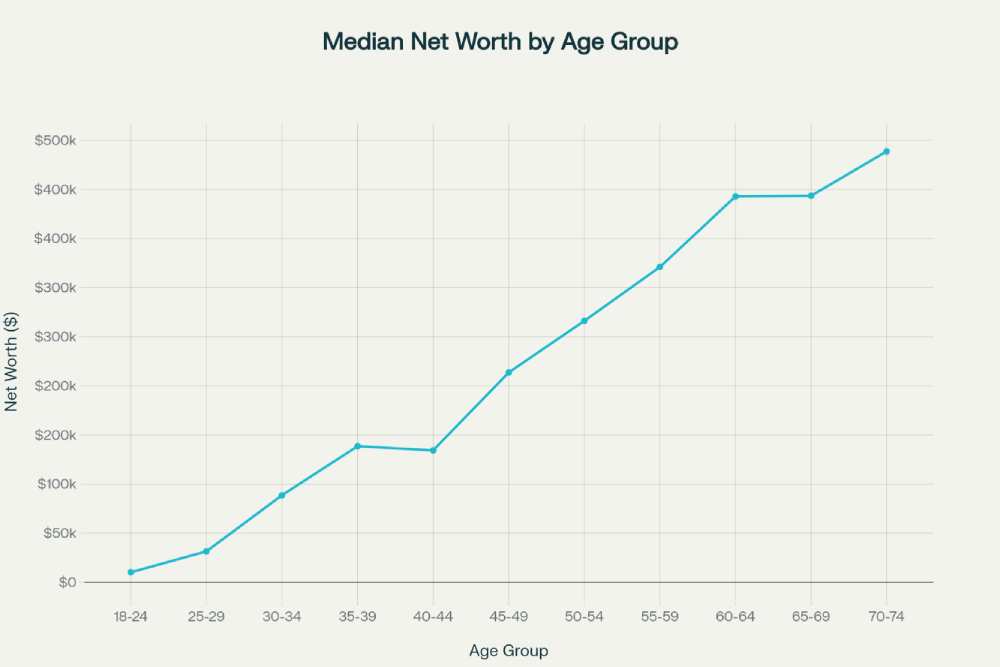
When you look at how different age groups develop money over time, you can see how consistently applying wealth-building strategies adds up over time. The graphic above demonstrates how median net worth changes with age. It indicates that acquiring wealth speeds up a lot between the ages of 35 and 60.
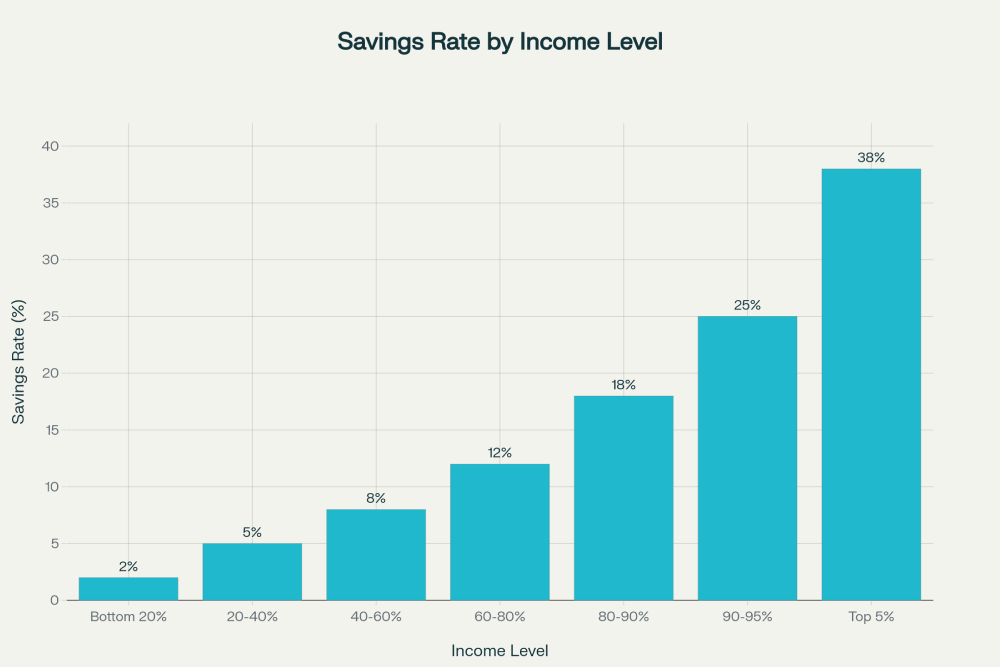
The most surprising thing regarding savings rates is that the wealthiest 5% of earnings save an average of 38% of their income, while the bottom 20% only save 2%. This 19-fold difference explains wealth divergence over 30-40 year careers. The pattern is the same in all countries and economic situations.
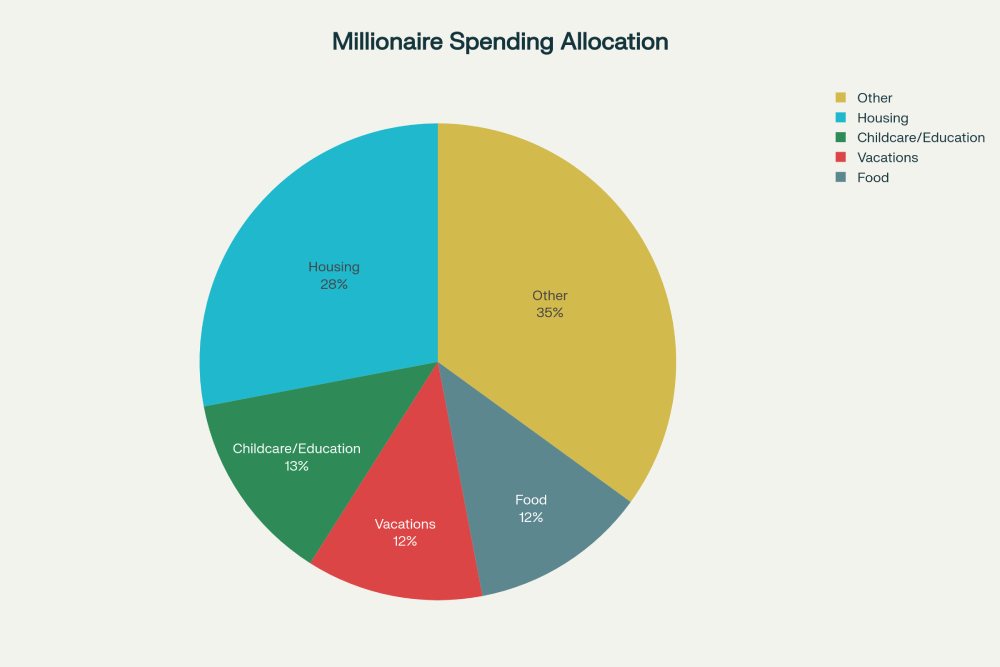
People with a lot of money plan how they spend it. Their biggest expense is housing (28% of their after-tax income), followed by holidays (12%), childcare/education (13%), and food (12%). They also put 35% of their money into other assets and wealth-building vehicles. This way of spending puts building wealth over lifestyle inflation.
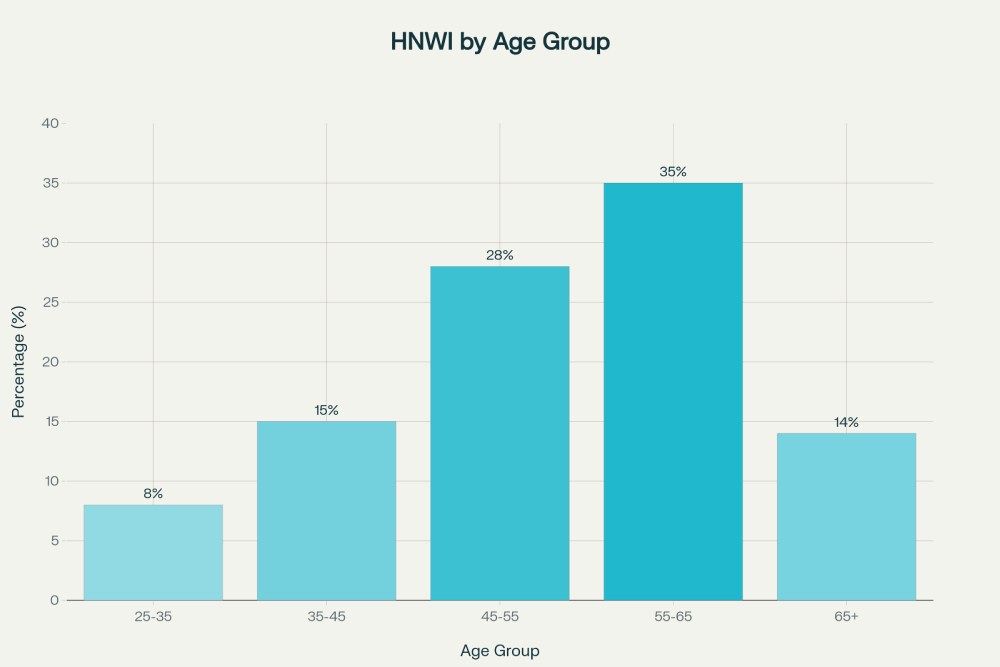
Most people with a lot of money are between the ages of 55 and 65 (35%), and a lot of them are also between the ages of 45 and 55 (28%). This shows that money usually builds up over 20 to 40 years of following rules for generating wealth, not by getting rich overnight.
The Psychology of Behavioral Finance: Why We Make Bad Money Choices
Traditional finance theory assumes that people make rational choices based on the knowledge they had. Behavioral finance contradicts this premise, showing that psychology has a bigger effect on financial results than information or simple earning ability.
Important psychological ideas that affect how people handle money are:
Present Bias: Putting too much weight on getting what you want right now instead of what you will get later. Rich people fight against this by using automation and visual reminders of their long-term aims.
Confirmation Bias: Looking for information that supports what you already believe and dismissing data that goes against it. Millionaires fight this by looking for different points of view and sources of information.
Herding Behavior: Making decisions based on what the herd says instead of your own research. When the market is in a panic, retail investors sell in a panic, whereas affluent people stay calm and even buy opportunities.
Recency Bias: Putting too much weight on recent occurrences when making choices. After recent crashes, investors might stay away from markets and miss out on the recoveries that followed. Rich investors stick to their plans no matter how well or badly things have gone recently.
The Illusion of Control: Thinking you can control what happens too much. This bias leads to too much trading. Rich investors know this and utilize tactics that are passive and systematic.
Money Psychology in Different Groups: How Age, Income, and Wealth Affect You
There are significant variances in wealth psychology based on age, according to research:
Young adults (18 to 35): They usually ponder about the future and how to take advantage of opportunities and reach their goals. They have more time, but they typically don’t have the discipline or experience. Their main mental difficulty is not giving in to lifestyle inflation when their income goes up.
Peak-Earning Years (35–55): This group has the best chance of building up their wealth. They balance their experience with their time frame and their ability to recognize opportunities with their disciplined practices. Studies suggest that this group of people gets the most out of learning how to generate wealth and investing in a systematic way.
Pre-Retirement (55-70): This demographic frequently transitions towards prosocial applications of wealth and legacy considerations. Older people seem to have a better grasp of wealth in a prosocial way than younger people do, focusing on how it might help others and their families. This change in how people think affects how they spend and invest their money.
Research in income-related psychology shows that being financially literate is more closely linked to wealth outcomes than just having a lot of money. A person who makes $60,000 and has good money habits generally ends up with more money than someone who makes $150,000 and has bad money habits and psychology.
Related Reading:
How to Earn 1 Cent per Second: Money Attraction Laws and Rules
How Typing Can Boost Your Productivity in this AI Era
10 Must-Have AI Tools Every Small Business Needs in 2025
How to Use ChatGPT at Work to Boost Productivity (2025)
How Behavioral Biases Affect Investment Choices?
Studies in behavioral finance have shown that psychological biases always get in the way of accumulating wealth, especially when it comes to making investment decisions:
Overtrading: Investors who are too sure of themselves trade too much, which costs them 0.5% to 2% of their gains each year. Wealthy investors fight this using methodical tactics that don’t change often.
Performance Chasing: Investors sometimes buy investments that have done well recently (herding) and then sell them when they go down (panic selling). People who act this way usually purchase high and sell low, which is the antithesis of generating wealth.
Not enough diversification: Some investors put too much money into one stock or area, thinking they can find winners. Rich investors know about this prejudice and make sure their portfolios are well-rounded.
Not enough risk assessment: Some investors take too much risk without knowing it, while others avoid required risks out of fear. Wealthy people make plans for how much risk they can take based on their status and schedule.
“The Psychology of Money” by Morgan Housel is among the most downloaded and discussed money psychology books in recent years. Rather than offering technical investment advice, Housel explores how perception, experience, and psychology shape financial decisions.


Cognitive Reframing: How to Build a Rich Mindset About Money
The inspiring fact is that you can learn and grow your wealth psychology. Studies on neuroplasticity show that when you exercise certain thought patterns on purpose, they change the way your brain works and change your behavior for good.
Step 1: Find Your Money Scripts
Start with becoming aware of what you now believe about money. Write in a journal about your childhood experiences with money and your current worries and beliefs. Are you using money scripts that are based on avoidance, worship, status, or vigilance? Change can’t happen without awareness.
Step 2: Change Your Limiting Beliefs
Change negative things you say into positive things you say:
- “Money doesn’t grow on trees” means “I can make money by creating value.”
- “I can’t afford it” becomes “How can I get the money to pay for it?”
- “Money is the root of all evil” means “Money gives you freedom and helps others.”
- “I don’t know how to handle money” → “I’m getting better at handling money every day.”
Step 3: Make habits that help you build wealth automatic
Reduce reliance on willpower by automating positive behaviours:
- Automatic payments to accounts that hold investments
- Plans for systematic investing
- Automating bill payments
- Automating debt repayment
Step 4: Learn to wait for what you want.
Do modest things every day on purpose to improve your impulse control. If you want to buy anything on impulse, wait 48 hours. Keep track of your choices and look for patterns.
Step 5: Read, listen to, and watch things that can help you build wealth
Read books, listen to podcasts, and watch videos about money psychology and investing. Your beliefs are shaped more by your friends and the information you take in than by individual choices.
Step 6: Make systems that hold people accountable
Join groups of people who want to grow money, engage with financial coaches, or make partnerships that hold you accountable. Social accountability makes people much more likely to follow through.
“The Millionaire Next Door” by Thomas J. Stanley and William D. Danko presents research from interviews with over 600 millionaires in America, revealing surprising truths about how wealthy people actually live. The study demolishes myths about luxury lifestyles and reveals that most millionaires are ordinary people with extraordinary financial discipline.

Beyond Money: The Intersection of Psychology, Philosophy, and Wealth
Interestingly, research from UC Berkeley reveals that even fake money could make people behave with less regard for others. This finding suggests that psychological effects of wealth extend beyond rational decision-making into empathy and social behavior. Wealthy people sometimes demonstrate lower empathy than lower-income individuals, though this relationship is complex and mediated by numerous factors.
Another surprising finding: there’s no direct correlation between income and happiness after a certain threshold (approximately $50,000-$75,000 annually in the US). After meeting basic needs and financial security, additional wealth produces minimal happiness gains. Some research suggests that the ceaseless striving for wealth creates unhappiness regardless of current income level.
This psychological complexity means that true wealth psychology extends beyond accumulation strategies to include purpose, meaning, and balanced life priorities.
Summary: The Transformational Power of Wealth Psychology
The psychology of money represents one of the most powerful leverage points for achieving financial freedom. Unlike increasing income (which requires market factors and employer decisions), transforming your money psychology lies entirely within your control.
Rich people think differently because they’ve deliberately developed thought patterns, beliefs, and habits that compound financial advantages over decades. By understanding behavioral finance principles, recognizing cognitive biases, and implementing the wealth-building habits of millionaires, you can fundamentally alter your financial trajectory.
The research is clear: wealth psychology matters more than income, cognitive discipline outweighs raw earning ability, and anyone can develop millionaire thinking through consistent practice and environmental design.
Your next step? Choose one wealth-building habit to implement this week. Start automating your savings, replace one limiting belief, or commit to tracking your spending. Small psychological shifts, consistently applied, create extraordinary financial outcomes over time.
Frequently asked questions
What sets apart the way a rich person thinks from the way an average person thinks?
The fundamental difference is how individuals think about resources and what they can do with them. Rich people believe there are adequate resources and that being creative may help them get through tough times. They don’t say “I can’t,” they question “How can I?” People who make an average amount of money usually work from a perspective of not having enough money and are frightened of taking chances. This difference in views influences all financial decisions, which has led to diverse outcomes over the years.
How long does it take to change from a poor to a rich mindset?
To change your mind, you normally have to practice new behaviors and ways of thinking for 30 to 90 days. But it usually takes two to three years of regular use to notice lasting changes in behavior.
Do rich people think about money in a different way than other people?
Yes, a lot. Millionaires don’t use money to judge their worth or stress them out. They see it as a way to get independence and opportunities, nevertheless. They don’t let their bank account balance tell them who they are, which helps them make better choices about money. They also think on the long term (decades instead of months) and focus on creating money and getting rich instead of wasting it.
What are the most important money habits that millionaires have in common?
People who are good with money often do things like pay themselves first (saving 20% or more), live within their means, keep track of their spending, establish multiple streams of income, keep learning, keep emergency funds, invest in assets that will go up in value, automate their financial systems, and think long-term. If you do these things all the time, they will add up to a lot of cash.
How does psychology affect the building of wealth?
Psychology affects how much money you make by controlling your impulses, waiting for rewards, controlling your emotions, accepting risks, and believing in certain things. People who can manage their feelings and have a positive attitude about money become wealthy two to three times faster than those who are impulsive and have bad money beliefs. This component of psychology is often more essential than how much money you have.
“If you found this article helpful, share it with your circle and Follow PingShopping on social media”
About the author